
RESULTADO DE ANÁLISE
Linha f2r.8
[ORG] kydain.shaiin.qoy.s.shol.fodan<->yksh.olsheey.daiildy
[ACA]
-
kydain = trabalhar e fixar/assentar (operar e deixar estabilizar sem reabrir)
-
shaiin = estado selado/fixado concluído
-
qoy = [UNK] (sem lema; há indícios de ser conector/qualificador “quanto a / no que toca a…”, mas não está estabilizado)
-
s = [UNK] (token isolado sem verbete; pode ser separador/abreviação interna)
-
shol = meio oleoso / banho de óleo (oleum)
-
fodan <-> yksh = [ALT]
-
fodan = assentamento pesado / sedimentação (deixar a fase densa descer)
-
yksh = encaminhar porção ao selo (direcionar para a etapa de selagem)
-
-
olsheey = selagem/solidificação em curso com oleação (fecho “oleado”)
-
daiildy = fração lavada/arrastada (separar a porção derivada do “lavado”)
[FUN] Trabalhe o lote e deixe assentar/estabilizar sem reabrir. Trate o sistema como selado/fixado e mantenha o regime no banho de óleo. Aqui existe uma bifurcação paleográfica importante:
-
Se for FODAN: provoque sedimentação pesada (sem agitar) até formar fundo claro; então siga para a selagem oleada (OLSHEEY) e separe a fração arrastada/lavada (DAIILDY) em coleta própria.
-
Se for YKSH: encaminhe a porção ao selo imediatamente; aplique a selagem oleada em curso (OLSHEEY) e recolha em separado a fração arrastada/lavada (DAIILDY).
Observação de rigor: QOY e S aparecem como conectores/qualificadores prováveis, mas não têm lema estável nesta versão — então ficam explicitamente como pendência.
Linha f2r.9
[ORG] dlssho.kol.sheey.qokey.ykody.so<->chol.yky.dain.daiirol
[ACA]
-
dlssho = continuação do método (“do procedimento”; mesmo bloco operacional)
-
kol = filtrado/colatura (líquido passado)
-
sheey = [FAM:SHE(…)] (não há lema “SHEEY”, mas a família -SHEEY/-SHEKY é produtiva e aponta para controle de selagem/fechamento em curso)
-
qokey = operador Q (reinjeção operacional / gesto técnico no slot ativo; “qual/algum” como seletor)
-
ykody = encaminhar fluxo para tratamento de cauda/resíduo (fundo)
-
so <-> chol = [ALT]
-
so = “sobre isso / sobre a porção” (conector topical)
-
chol = “com/por meio de” (conector instrumental)
-
-
yky = ação de trabalho focado (operar com foco no alvo)
-
dain = genitivo curto “de/do/da” (origem)
-
daiirol = registro corrido do processo (log operacional)
[FUN] Mantenha a sequência no mesmo método: trabalhe com o filtrado (KOL) sob controle de fechamento/selagem em curso (SHEEY entendido como família). Execute o operador de reinjeção operacional (QOKEY), mas trate também a cauda/resíduo (YKODY) separadamente. Neste ponto, o texto alterna entre:
-
SO: operar “sobre esta porção” (topical),
-
ou CHOL: operar “por meio de / com instrumento” (instrumental).
Depois, trabalhe com foco (YKY) a partir da origem (DAIN) e registre o estado/resultado no log do processo (DAIIROL).
Linha f2r.10
[ORG] qoky.cholaiin.shol.sheky.daiin<->cthey.keol.saiin.saiin
[ACA]
-
qoky = genitivo curto “de/do/da” (origem/pertencimento) + leitura de “reinjeção de ciclo” na camada Q
-
cholaiin = CHOL em estado selado/concluído (bloco/recipiente “CHOL-fechado”)
-
shol = banho de óleo (meio)
-
sheky = selagem/solidificação ativa (controle de fechamento em curso)
-
daiin <-> cthey = [ALT]
-
daiin = estado fixado/assentado (família D-; “assentou, estabilizou”)
-
cthey = conector de ancoragem/ligação (amarrar o passo ao ponto)
-
-
keol = conector relativo (hipótese “qui ’l”; valor de ligação)
-
saiin.saiin = estado registrado/concluído em duplicação (duplo registro / reforço do estado)
[FUN] A partir da origem (QOKY), mantenha o conjunto em CHOLAIIN (estado selado do bloco instrumental) sob banho de óleo (SHOL) e com selagem ativa (SHEKY) até o critério de estabilidade. Na leitura do trecho, entra uma alternativa:
-
Se DAIIN: o texto afirma a fixação/assentamento como estado atingido.
-
Se CTHEY: o texto manda ancorar/ligar o procedimento ao ponto (como um “amarre aqui”).
Em ambos os casos, KEOL funciona como ponte de ligação e SAIIN.SAIIN indica reforço do estado registrado (interprete como “dupla confirmação/dupla passagem de registro”, não como novo reagente).
Linha f2r.11
[ORG] ychain.dal.chy.dalor.shan.dan<->olsaiin.sheey.ckhor
[ACA]
-
ychain = seleção de fração (escolher a porção-alvo na cadeia)
-
dal = “da/do” (origem)
-
chy = seletor de alvo (“qual / qual deles”)
-
dalor = solvente suave preparado (água doce/solvente leve em estado pronto)
-
shan = escuma/espuma (camada superior)
-
dan <-> olsaiin = [ALT]
-
dan = marcador de microdose / fechamento de dose (encerrar porção)
-
olsaiin = estado locativo-registrado (“no estado/registrado” — OL + SAIIN)
-
-
sheey = [FAM:SHE(…)] (controle de fechamento em curso; ver nota da L9)
-
ckhor = checagem do núcleo (“coração” do lote; checkpoint central)
[FUN] Selecione a fração-alvo (YCHAIN) da origem indicada (DAL) e determine o alvo específico (CHY). Aplique o solvente suave (DALOR) e trate a escuma do topo (SHAN) como fração distinta (retirar/limpar). Em seguida, o texto oscila entre:
-
DAN: encerrar a porção por microdose de fechamento,
-
ou OLSAIIN: declarar que a porção está no estado registrado/concluído.
Depois, mantenha o controle de fechamento/selagem em curso (SHEEY como família) e faça a checagem do núcleo (CKHOR) antes de avançar.
Linha f2r.12
[ORG] okol.chy.chor.cthor.yor.an.chan<->saiin.chety.chyky.sal
[ACA]
-
okol = estabilizar/assentar condição (deixar “ficar certo”)
-
chy = seletor de alvo
-
chor = modo cíclico / repetição controlada (lavar–tornar–operar)
-
cthor = [NUC/VAR] (não há lema “CTHOR” isolado; a família sugere “nó/conector/ponto de junção”, mas há conflito com leituras instrumentais. Trato como “ponto de junção” com cautela.)
-
yor = componente metálico “ouro” (folha/pó/sal aurífero) como alvo/marker
-
an = conector curto (e/em/para)
-
chan <-> saiin = [ALT]
-
chan = [NUC] canal/tubo de passagem (inferível via verbetes compostos como OKCHAN)
-
saiin = estado registrado/concluído
-
-
chety = “estes/estes itens” (deítico plural)
-
chyky = modo ativo de operação (ajuste de intensidade/ritmo)
-
sal = reagente salino (base)
[FUN] Estabilize o lote (OKOL) e selecione o alvo (CHY) para operar em modo cíclico (CHOR), passando pelo ponto de junção/encaixe (CTHOR). Aplique o componente de ouro (YOR) conforme o protocolo (como adição em traço fino ou marcador de qualidade) e siga o encadeamento (AN). Depois, há a alternativa:
-
CHAN: conduzir por canal/tubo (transferência guiada),
-
ou SAIIN: declarar o estado já registrado/concluído.
Em seguida, opere sobre este conjunto de itens (CHETY) em modo ativo (CHYKY) e introduza o sal (SAL) na dosagem/condição pedida pelo contexto.
Linha f2r.13
[ORG] sho.ykeey.chey.daiin.chcthy<$>
[ACA]
-
sho = impessoal procedural (“faz-se / aplica-se” — comando sem sujeito)
-
ykeey = marcador de ponto exato (“aqui, exatamente aqui” — controle)
-
chey = [NUC] ponte relativa/final (“que/ao que/para que…”) (não há lema CHEY isolado, mas a família ALCHEY/ADCHEY aponta para este núcleo)
-
daiin = estado fixado/assentado (família D-)
-
chcthy = “o que / aquilo que” (relativo de retomada)
-
<$> = fecho do trecho no seu corpus
[FUN] Aplica-se o passo exatamente neste ponto de controle (YKEEY). Em seguida, use o relativo (CHEY) para amarrar “o que foi feito” ao estado final: mantenha fixado/assentado (DAIIN) aquilo que foi processado (CHCTHY), encerrando o bloco.
Síntese procedural do trecho
Este bloco tem uma assinatura bem “operacional”, com cara de laboratório:
trabalhar + estabilizar (KYDAIN/SHAIIN) → regime em banho de óleo (SHOL) → sedimentar ou encaminhar ao selo (FODAN / YKSH) → selagem oleada em curso (OLSHEEY) → separar frações lavadas/caudas (DAIILDY / YKODY) → reinjeção/recirculação (QOKY/QOKEY) → bloco instrumental selado (CHOLAIIN) → dupla confirmação de estado (SAIIN.SAIIN) → seleção de frações + solvente suave + retirada de escuma (YCHAIN/DALOR/SHAN) → checkpoint do núcleo (CKHOR) → modo cíclico + junção + componente “ouro” + canalização/registro + sal em modo ativo (CHOR/CTHOR/YOR/CHAN/SAIIN/SAL) → aplicação pontual e fixação do “aquilo que” (YKEEY/DAIIN/CHCTHY).
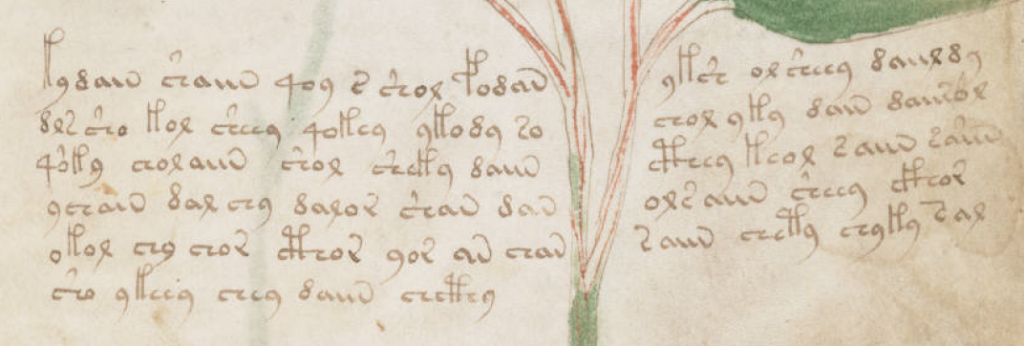
<f2r.8,+P0> <%>kydain.shaiin.qoy.s.shol.fodan<->yksh.olsheey.daiildy
<f2r.9,+P0> dlssho.kol.sheey.qokey.ykody.so<->chol.yky.dain.daiirol
<f2r.10,+P0> qoky.cholaiin.shol.sheky.daiin<->cthey.keol.saiin.saiin
<f2r.11,+P0> ychain.dal.chy.dalor.shan.dan<->olsaiin.sheey.ckhor
<f2r.12,+P0> okol.chy.chor.cthor.yor.an.chan<->saiin.chety.chyky.sal
<f2r.13,+P0> sho.ykeey.chey.daiin.chcthy<$>
ANALYSIS RESULT
Line f2r.8
[ORG] kydain.shaiin.qoy.s.shol.fodan<->yksh.olsheey.daiildy
[ACA]
-
kydain = work and fix/settle (operate and let it stabilize without reopening)
-
shaiin = sealed/fixed state completed
-
qoy = [UNK] (no stable lemma; there are signs it may be a connector/qualifier “as for / with regard to…”, but it is not stabilized)
-
s = [UNK] (isolated token with no entry; may be an internal separator/abbreviation)
-
shol = oily medium / oil bath (oleum)
-
fodan <-> yksh = [ALT]
-
fodan = heavy settling / sedimentation (let the dense phase drop)
-
yksh = route a portion to the seal (direct to the sealing stage)
-
-
olsheey = sealing/solidification in progress with oiling (an “oiled” closure)
-
daiildy = washed/dragged fraction (separate the portion derived from the “washed” stream)
[FUN] Work the batch and let it settle/stabilize without reopening. Treat the system as sealed/fixed and keep the regime in the oil bath. There is an important paleographic fork here:
-
If it is FODAN: induce heavy sedimentation (no agitation) until a clear bottom forms; then proceed to the oiled sealing (OLSHEEY) and separate the dragged/washed fraction (DAIILDY) into a dedicated collection.
-
If it is YKSH: route the portion to the seal immediately; apply the oiled sealing in progress (OLSHEEY) and collect separately the dragged/washed fraction (DAIILDY).
Rigor note: QOY and S appear as likely connectors/qualifiers, but do not have stable lemmas in this version—so they remain explicitly pending.
Line f2r.9
[ORG] dlssho.kol.sheey.qokey.ykody.so<->chol.yky.dain.daiirol
[ACA]
-
dlssho = continuation of the method (“of the procedure”; same operational block)
-
kol = filtrate/colature (passed liquid)
-
sheey = [FAM:SHE(…)] (there is no stable lemma “SHEEY”, but the -SHEEY/-SHEKY family is productive and points to sealing/closure control in progress)
-
qokey = Q operator (operational reinjection / technical gesture in the active slot; “which/some” as a selector)
-
ykody = route flow to tail/residue treatment (bottom)
-
so <-> chol = [ALT]
-
so = “on that / on the portion” (topical connector)
-
chol = “with/by means of” (instrumental connector)
-
-
yky = focused-work action (operate with focus on the target)
-
dain = short genitive “of/from” (origin)
-
daiirol = continuous process record (operational log)
[FUN] Keep the sequence in the same method: work with the filtrate (KOL) under closure/sealing control in progress (SHEEY understood as a family). Execute the operational reinjection operator (QOKEY), but also treat the tail/residue (YKODY) separately. At this point, the text alternates between:
-
SO: operate “on this portion” (topical),
-
or CHOL: operate “by means of / with an instrument” (instrumental).
Then, work with focus (YKY) from the origin (DAIN) and record the state/result in the process log (DAIIROL).
Line f2r.10
[ORG] qoky.cholaiin.shol.sheky.daiin<->cthey.keol.saiin.saiin
[ACA]
-
qoky = short genitive “of/from” (origin/possession) + reading of “cycle reinjection” in the Q layer
-
cholaiin = CHOL in a sealed/completed state (instrumental “CHOL-closed” block/container)
-
shol = oil bath (medium)
-
sheky = active sealing/solidification (closure control in progress)
-
daiin <-> cthey = [ALT]
-
daiin = fixed/settled state (D- family; “it settled, stabilized”)
-
cthey = anchoring/linking connector (tie the step to the point)
-
-
keol = relative connector (hypothesis “qui ’l”; linking value)
-
saiin.saiin = recorded/completed state in duplication (double record / reinforcement of state)
[FUN] From the origin (QOKY), keep the set in CHOLAIIN (sealed state of the instrumental block) under the oil bath (SHOL) and with active sealing (SHEKY) until the stability criterion. In this segment, an alternative appears:
-
If DAIIN: the text states fixation/settling as the reached state.
-
If CTHEY: the text instructs you to anchor/tie the procedure to the point (like a “tie it here”).
In both cases, KEOL functions as a linking bridge, and SAIIN.SAIIN indicates reinforcement of the recorded state (read as “double confirmation/double logging pass,” not as a new reagent).
Line f2r.11
[ORG] ychain.dal.chy.dalor.shan.dan<->olsaiin.sheey.ckhor
[ACA]
-
ychain = fraction selection (choose the target portion in the chain)
-
dal = “of/from” (origin)
-
chy = target selector (“which / which one”)
-
dalor = prepared mild solvent (fresh water / light solvent in ready state)
-
shan = scum/foam (top layer)
-
dan <-> olsaiin = [ALT]
-
dan = microdose marker / dose closure (close the portion)
-
olsaiin = locative-recorded state (“in the state/recorded” — OL + SAIIN)
-
-
sheey = [FAM:SHE(…)] (closure control in progress; see note on L9)
-
ckhor = core check (“heart” of the batch; central checkpoint)
[FUN] Select the target fraction (YCHAIN) from the indicated origin (DAL) and determine the specific target (CHY). Apply the mild solvent (DALOR) and treat the top scum (SHAN) as a distinct fraction (remove/clean). Next, the text oscillates between:
-
DAN: close the portion via a microdose closure,
-
or OLSAIIN: declare that the portion is in the recorded/completed state.
After that, keep closure/sealing control in progress (SHEEY as a family) and perform the core check (CKHOR) before advancing.
Line f2r.12
[ORG] okol.chy.chor.cthor.yor.an.chan<->saiin.chety.chyky.sal
[ACA]
-
okol = stabilize/settle the condition (let it “become correct”)
-
chy = target selector
-
chor = cyclic mode / controlled repetition (wash–return–operate)
-
cthor = [NUC/VAR] (there is no stable lemma “CTHOR” in isolation; the family suggests “knot/connector/junction point,” but there is conflict with instrumental readings. I treat it as “junction point” cautiously.)
-
yor = metallic component “gold” (leaf/powder/auric salt) as a target/marker
-
an = short connector (and/in/to/for)
-
chan <-> saiin = [ALT]
-
chan = [NUC] channel/pass-through tube (inferable via compound entries such as OKCHAN)
-
saiin = recorded/completed state
-
-
chety = “these/these items” (plural deictic)
-
chyky = active operating mode (intensity/rhythm adjustment)
-
sal = saline reagent (base)
[FUN] Stabilize the batch (OKOL) and select the target (CHY) to operate in cyclic mode (CHOR), passing through the junction/attachment point (CTHOR). Apply the gold component (YOR) per protocol (as a trace addition or quality marker) and follow the chaining (AN). Then an alternative appears:
-
CHAN: conduct through a channel/tube (guided transfer),
-
or SAIIN: declare the state already recorded/completed.
Next, operate on this set of items (CHETY) in active mode (CHYKY) and introduce the salt (SAL) at the dosage/condition required by context.
Line f2r.13
[ORG] sho.ykeey.chey.daiin.chcthy<$>
[ACA]
-
sho = impersonal procedural (“one does / apply” — subjectless command)
-
ykeey = exact-point marker (“here, exactly here” — control)
-
chey = [NUC] relative/final bridge (“that/which/so that…”) (there is no stable lemma CHEY in isolation, but the ALCHEY/ADCHEY family points to this core)
-
daiin = fixed/settled state (D- family)
-
chcthy = “that which / what” (resumptive relative)
-
<$> = end-of-segment marker in your corpus
[FUN] Apply the step exactly at this control point (YKEEY). Then use the relative (CHEY) to bind “what was done” to the final state: keep fixed/settled (DAIIN) that which was processed (CHCTHY), closing the block.
Procedural synthesis of the segment
This block has a very “operational” signature—lab-like:
work + stabilize (KYDAIN/SHAIIN) → oil-bath regime (SHOL) → sediment or route to the seal (FODAN / YKSH) → oiled sealing in progress (OLSHEEY) → separate washed/tail fractions (DAIILDY / YKODY) → reinjection/recirculation (QOKY/QOKEY) → sealed instrumental block (CHOLAIIN) → double state confirmation (SAIIN.SAIIN) → fraction selection + mild solvent + scum removal (YCHAIN/DALOR/SHAN) → core checkpoint (CKHOR) → cyclic mode + junction + “gold” component + channeling/recording + salt in active mode (CHOR/CTHOR/YOR/CHAN/SAIIN/SAL) → point-application and fixation of “that which” (YKEEY/DAIIN/CHCTHY).