
RESULTADO DE ANÁLISE
Linha f2v.1
[ORG] kooiin.cheo.pchor.otaiin.o.dain.chor<->dair.shty
[ACA]
-
kooiin = inspeção visual / checagem de estado
-
cheo = porção/seção (payload do passo)
-
pchor = ciclo de variação (processo sob alternância)
-
otaiin = estado de fixação (-AIIN) (ainda instável no léxico; tratado como estado pela forma)
-
o = conector curto (“e/então/para”) (sem verbete dedicado)
-
dain = marcador de processo/estado (família D-) (entrada dependente do contexto)
-
chor = ciclo/processo (rotina operativa)
-
<-> = conector bidirecional (transição/transferência entre estágios) (marcação do corpus)
-
dair = licor claro (fração aquosa clarificada)
-
shty = conclusão/selagem de etapa (valor de “fecho do passo” no seu texto atual)
[FUN]
Faça a inspeção visual da porção ativa durante o ciclo de variação até observar o sistema em estado de fixação. Em seguida, passe ao eixo de transferência indicado e recolha o licor claro, encerrando esta etapa com o fecho/selagem do passo.
Notas críticas (rigor):
-
OTAIIN ainda não está plenamente estabilizado como verbete no léxico; aqui eu o trato como estado por terminar em -AIIN, mas ele permanece candidato a validação.
-
O aparece como conector na sua leitura; sem verbete dedicado, fica marcado como [CON].
Linha f2v.2
[ORG] kcho.kchy.sho.shol.qotcho.loeees.qoty<->chor.daiin
[ACA]
-
kcho = manejo operativo (ação de condução)
-
kchy = controle/inspeção (checagem operacional)
-
sho = ação mandatória (“execute”)
-
shol = meio oleoso / banho de óleo
-
qotcho = prova/toque de verificação (modo comando + teste)
-
loeees = matérias / cargas selecionadas (plural/coleção; intensificação possível)
-
qoty = seleção/recorte em modo comando (“selecionar/pegar as porções”) — leitura funcional
-
<-> = transição/transferência entre estágios
-
chor = ciclo/processo
-
daiin = estado assentado/fixado (família D- + -AIIN)
[FUN]
Conduza o manejo do passo e faça a checagem de controle. Execute obrigatoriamente a operação no banho de óleo e aplique o teste de toque/verificação sobre as matérias selecionadas. Em seguida, realize a transferência indicada e mantenha o ciclo em estado assentado/fixado antes de avançar.
Linha f2v.3
[ORG] otchy.chor.lshy.chol.chody.chodain<->chcthy.daiin
[ACA]
-
otchy = avaliação/teste (passo de verificação ativa)
-
chor = ciclo/processo
-
lshy = fluxo (marcador de condução/fluxo)
-
chol = via instrumental / instrumento (rota do aparato)
-
chody = fração conduzida (payload em condução)
-
chodain = registro/fixação do payload (fixado/assentado; família D-)
-
<-> = transição/transferência
-
chcthy = aquilo-que / componente-âncora (relativo/âncora; leitura estrutural)
-
daiin = estado assentado/fixado (-AIIN)
[FUN]
Faça a etapa de teste do ciclo e avalie o fluxo através do instrumental. Encaminhe a fração conduzida para que seja transferida e registrada como fixada, garantindo que o componente-âncora (“aquilo-que” está sendo processado) permaneça em estado assentado/fixado.
Nota crítica (rigor):
-
CHCTHY aparece como relativo/âncora na sua leitura; se ele ainda não estiver estabilizado no seu léxico, mantenha-o como âncora estrutural provisória, e não como “tradução” sem suporte.
Linha f2v.4
[ORG] sho.cholo.cheor.chodaiin
[ACA]
-
sho = ação mandatória (execute)
-
cholo = via instrumental (rota do aparato)
-
cheor = aeração/ventilação (abrir, dissipar, arejar)
-
chodaiin = transferência/registro fixado (família D- + -AIIN)
[FUN]
Execute obrigatoriamente, por via do instrumental, a etapa de aeração/ventilação da mistura e finalize com a transferência registrada e fixada do material, encerrando o ciclo em estado estável.
Síntese procedural do trecho (leitura reconstruída)
O bloco descreve uma sequência coerente de:
inspeção → variação controlada → fixação → coleta do licor claro → teste em banho de óleo → verificação por toque → repouso/assentamento → teste de fluxo via aparato → transferência e registro de fixação → ventilação → fixação final
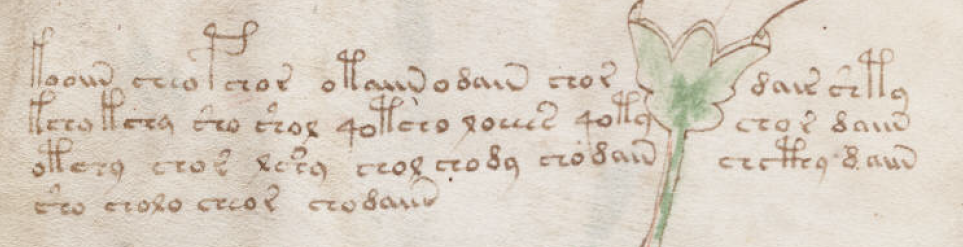
<f2v.1,@P0> <%>kooiin.cheo.pchor.otaiin.o.dain.chor<->dair.shty
<f2v.2,+P0> kcho.kchy.sho.shol.qotcho.loeees.qoty<->chor.daiin
<f2v.3,+P0> otchy.chor.lshy.chol.chody.chodain<->chcthy.daiin
<f2v.4,+P0> sho.cholo.cheor.chodaiin<$>
ANALYSIS RESULT
Line f2v.1
[ORG] kooiin.cheo.pchor.otaiin.o.dain.chor<->dair.shty
[ACA]
-
kooiin = visual inspection / state check
-
cheo = portion/section (step payload)
-
pchor = variation cycle (process under alternation)
-
otaiin = fixation state (-AIIN) (still unstable in the lexicon; treated as a state by form)
-
o = short connector (“and/then/for”) (no dedicated entry)
-
dain = process/state marker (D- family) (context-dependent entry)
-
chor = cycle/process (operative routine)
-
<-> = bidirectional connector (transition/transfer between stages) (corpus markup)
-
dair = clear liquor (clarified aqueous fraction)
-
shty = conclusion/sealing of the step (“step closure” value in your current text)
[FUN]
Perform a visual inspection of the active portion during the variation cycle until you observe the system in a fixation state. Then, move to the indicated transfer axis and collect the clear liquor, closing this stage with the closure/sealing of the step.
Critical notes (rigor):
-
OTAIIN is not yet fully stabilized as a lexicon entry; here I treat it as a state because it ends in -AIIN, but it remains a validation candidate.
-
O appears as a connector in your reading; without a dedicated entry, it remains marked as [CON].
Line f2v.2
[ORG] kcho.kchy.sho.shol.qotcho.loeees.qoty<->chor.daiin
[ACA]
-
kcho = operative handling (conducting action)
-
kchy = control/inspection (operational check)
-
sho = mandatory action (“execute”)
-
shol = oily medium / oil bath
-
qotcho = proof/check touch (command mode + test)
-
loeees = materials / selected loads (plural/collection; possible intensification)
-
qoty = selection/cut in command mode (“select/pick the portions”) — functional reading
-
<-> = transition/transfer between stages
-
chor = cycle/process
-
daiin = settled/fixed state (D- family + -AIIN)
[FUN]
Conduct the handling of the step and perform the control check. Execute the operation mandatorily in the oil bath and apply the touch/verification test to the selected materials. Then perform the indicated transfer and keep the cycle in a settled/fixed state before advancing.
Line f2v.3
[ORG] otchy.chor.lshy.chol.chody.chodain<->chcthy.daiin
[ACA]
-
otchy = evaluation/test (active verification step)
-
chor = cycle/process
-
lshy = flow (guidance/flow marker)
-
chol = instrumental route / instrument (apparatus path)
-
chody = carried fraction (payload in transit)
-
chodain = record/fixation of the payload (fixed/settled; D- family)
-
<-> = transition/transfer
-
chcthy = the-thing-which / anchor component (relative/anchor; structural reading)
-
daiin = settled/fixed state (-AIIN)
[FUN]
Perform the cycle’s test stage and evaluate the flow through the apparatus. Route the carried fraction so it can be transferred and recorded as fixed, ensuring that the anchor component (“the-thing-which” is being processed) remains in a settled/fixed state.
Critical note (rigor):
-
CHCTHY appears as a relative/anchor in your reading; if it is not yet stabilized in your lexicon, keep it as a provisional structural anchor, not as a “translation” without support.
Line f2v.4
[ORG] sho.cholo.cheor.chodaiin
[ACA]
-
sho = mandatory action (execute)
-
cholo = instrumental route (apparatus path)
-
cheor = aeration/venting (open, dissipate, air out)
-
chodaiin = transfer/recorded fixation (D- family + -AIIN)
[FUN]
Execute, mandatorily, via the apparatus, the aeration/venting stage of the mixture and finish with the recorded, fixed transfer of the material, closing the cycle in a stable state.
Procedural synthesis of the excerpt (reconstructed reading)
The block describes a coherent sequence of:
inspection → controlled variation → fixation → collection of clear liquor → oil-bath test → touch verification → rest/settling → flow test via apparatus → transfer and fixation record → venting → final fixation