
f89r1.15
[ORG] tcheol qoeair sheol qocphey saiin cheocphey dal darolm
[ACA]
-
tcheol = [VAR] ponte relativa do tipo CHEOL/CHOTCHEOL (“que o / com que o”)
-
qoeair = operador QO- (reinjeção operacional / retorno ao ciclo)
-
sheol = estado de selagem completa (sistema fechado/solidificado)
-
qocphey = [VAR] QO- + CPHEY (execução/slot no recipiente sob reinjeção)
-
saiin = estado registrado/passivo (estado assumido/confirmado)
-
cheocphey = verter/trasfegar ao vaso alvo (transferência limpa)
-
dal = ponte genitiva do/da (procedência)
-
darolm = [UNK] (provável família DAROL/AIROLM/TCHDAROL: acoplamento/fecho/selante; baixa certeza)
[FUN]
Trate tcheol como ponte de referência (“o que está em foco no passo”). Reinjete o meio/fluxo no ciclo (qoeair) mantendo o sistema totalmente selado (sheol). Execute o gesto “em recipiente/slot” em regime QO (qocphey) até o estado ficar registrado/assumido (saiin). Em seguida trasfegue a fração ao vaso de destino (cheocphey), preservando a marca de procedência (dal). darolm parece qualificar o fecho/encaixe do aparato, mas fica pendente como identificação firme.
f89r1.16
[ORG] om sheey qokey l daiin dal chom chekechy chol cheos aiin dy
[ACA]
-
om = [MORF/UNK] marcador isolado (compatível com “porção/massa/modo -OM”, mas não está como entrada única)
-
sheey = [FAMÍLIA SHE/…EEY] selagem/solidificação ativa (ação em curso)
-
qokey = operador QO- (reinjeção/retorno ao slot ativo)
-
l = [PFX L-] marca de forma/slot nominal (aparece como prefixo no dicionário; aqui veio “solto”)
-
daiin = estado fixado/assentado (família D-)
-
dal = do/da (procedência)
-
chom = mistura base / composto matriz
-
chekechy = cal viva / base alcalina forte (família CHEK)
-
chol = via/meio/instrumento/condição (“por meio de…”)
-
cheos = [FAMÍLIA CHEO+S…] fração já vertida/selecionada (ex.: CHEOSAIIN/CHEOSDY)
-
aiin = estado fixado/registrado
-
dy = de/do/da (origem/pertencimento)
[FUN]
Tome a porção (om) e mantenha a selagem ativa (sheey) enquanto executa a reinjeção operacional no slot (qokey). Faça o sistema atingir estado assentado (daiin) e deixe explícita a procedência (dal). Trabalhe a partir da massa matriz (chom) introduzindo cal viva (chekechy) via um meio/instrumento do aparato (chol). Use a fração já vertida/limpa (cheos) e finalize registrando/fixando o estado (aiin), marcando novamente a relação de origem (dy).
f89r1.17
[ORG] qeaiin cheol seey qotey qokeeol daiin ykeedy daiin dam
[ACA]
-
qeaiin = [VAR] estado tipo EAIIN sob qualificação Q- (fecho/fixação em regime de reinjeção; não há entrada exata “QEAIIN”)
-
cheol = ponte relativa (CHEOL: “que o / o qual”)
-
seey = operador de manter em ação/incorporação em fluxo (evitar estase)
-
qotey = [VAR/UNK] provável QOT- + -EY (comando de fechamento/chiudi em regime QOT; não há entrada exata)
-
qokeeol = operador QO- (reinjeção operacional; retorno ao ciclo/slot)
-
daiin = estado fixado/assentado
-
ykeedy = [VAR] encadeamento Y- + KEEDY (payload “KEEDY” = extrato/resíduo obtido; “e então + produto”)
-
daiin = fixar novamente (segunda estabilização)
-
dam = [MORF/UNK] marcador solto (família “-DAM” aparece em muitos tokens, mas não como entrada única)
[FUN]
Coloque o procedimento em estado de fixação/fecho qualificado (qeaiin) e use cheol para amarrar o referente do passo. Mantenha o material em incorporação ativa (seey) e aplique o fechamento em regime de comando (qotey, variante provável). Retorne ao ciclo com reinjeção operacional (qokeeol), estabilizando em daiin. Em seguida, adicione/incorpore o payload KEEDY como continuação do encadeamento (ykeedy) e fixe novamente (daiin). O final dam parece fechar o passo como marcador de modo/resultado, mas fica como leitura morfológica pendente.
f89r1.18
[ORG] dals al dal cheody dainaldy al daldal
[ACA]
-
dals = fração salina (sais presentes; ajustar solubilização/decantação)
-
al = ponte de destino (“ao/à”)
-
dal = ponte de origem (“do/da”)
-
cheody = [FAMÍLIA CHEO+DY] verter/trasfegar (ex.: DCHEODY/LCHEODY/OLCHEODY)
-
dainaldy = [COMP] DAIN + ALDY (procedência reforçada: “do/da + de/di”)
-
al = destino novamente
-
daldal = origem duplicada (reforço de procedência)
[FUN]
Separe/trate a fração salina (dals) e direcione-a ao alvo do passo (al), mantendo clara a procedência (dal). Trasfegue a fração (cheody) sem puxar borra. Use dainaldy como reforço de “procedência composta” (origem bem amarrada: do… de…), retorne ao destino (al) e finalize reforçando o vínculo de origem com daldal (duplicação proposital).
f89r1.19
[ORG] pshol sheo ?oaithy cheoepey s sheor qokair y dam daly
[ACA]
-
pshol = banho de óleo / meio oleoso (oleum)
-
sheo = controle de selagem/solidificação (SHE-)
-
?oaithy = [CASO ESPECIAL] [VAR] O- + AITHY (AITHY = item/condição-ponte; o “O-” qualifica; o “?” indica incerteza real)
-
cheoepey = verter/trasfegar (transferência limpa)
-
s = [MORF/UNK] marcador isolado (provável plural/coletivo/ênfase; não existe entrada “S”)
-
sheor = controle de selagem/solidificação
-
qokair = [VAR] QO- + KAIR (conector “ao qual / referente” sob regime QO; KAIR existe, QOKAIR não)
-
y = operador de encadeamento (Y-) em forma mínima (não há entrada “Y” isolada)
-
dam = [MORF/UNK] marcador solto de modo/resultado
-
daly = ponte genitiva “do/da (selado)” (procedência marcada)
[FUN]
Trabalhe em banho de óleo (pshol) e mantenha o controle de selagem (sheo). A condição oaithy é um ponto sensível: opera como “item/condição” qualificada por O-, mas o manuscrito (e sua marca “?”) exige cautela — trate como condição operacional do passo. Trasfegue a fração (cheoepey), possivelmente em conjunto/coletivo (s, pendente), e reafirme a selagem (sheor). Use qokair para amarrar “ao qual/referente” dentro do regime de reinjeção, encadeie o passo (y), feche o modo/resultado (dam, pendente) e marque a procedência como origem selada (daly).
f89r1.20
[ORG] daim cheom qoaikhy air cheody ldain dal chom chtaem
[ACA]
-
daim = [VAR] locativo/interior (família DYDAIM = “de dentro”; aqui “dentro/no interior”)
-
cheom = trasfegar fração (transferência)
-
qoaikhy = [VAR] QO- + AIKHY (AIKHY = ponte/relativo; QO- qualifica o encadeamento)
-
air = meio de ar/aeração (instrumento/condição)
-
cheody = [FAMÍLIA CHEO+DY] verter/trasfegar
-
ldain = estado/fecho nominal (L-DAIN) (estado assumido/estabilizado)
-
dal = do/da
-
chom = massa matriz / mistura base
-
chtaem = módulo térmico (cozer/aquecer / regime de calor)
[FUN]
No interior do vaso (daim), faça uma transferência controlada (cheom) e use qoaikhy como ponte qualificada (amarração lógica do passo em regime QO). Aplique ar/aeração (air) como condição do processo e então trasfegue (cheody). Estabilize em estado nominal (ldain), mantendo a marca de procedência (dal). Volte à massa matriz (chom) e aplique o regime térmico (chtaem) conforme a necessidade do ponto.
f89r1.21
[ORG] taiin dam shoety dal qokchy ykchdy otcham ol rchs aiin
[ACA]
-
taiin = [VAR] estado de registro/fixação (famílias ETAIIN/LTAIIN/SOTAIIN; “TAIIN” puro não está como entrada)
-
dam = [MORF/UNK] marcador de modo/resultado
-
shoety = [VAR/UNK] provável família ligada a OETY (marcador/fecho em uso) com qualificação SH- (selagem)
-
dal = do/da (origem)
-
qokchy = operador QO- (reinjeção operacional; retorno ao ciclo)
-
ykchdy = [VAR] encadeamento Y- + KCHDY (“e daqui/neste ponto…”)
-
otcham = [VAR] família CHAM (dose medida/porção calibrada); há entrada QOTCHAM, aqui veio sem QOT-
-
ol = ao/para o (destino)
-
rchs = [VAR/UNK] provável RCH + -S (RCH = jarro/vaso intermediário; “-S” qualifica/coletiviza)
-
aiin = estado fixado/registrado
[FUN]
Fixe o passo em estado de registro (taiin) e trate dam como fechamento de modo/resultado do subciclo (pendente como forma isolada). Mantenha o fecho operacional (shoety, provável variante) e preserve a origem (dal). Faça a reinjeção operacional (qokchy) e, a partir deste ponto (ykchdy), introduza uma dose calibrada (otcham). Direcione ao recipiente intermediário (ol + rchs) e finalize com estado fixado (aiin).
f89r1.22
[ORG] ysheeo r sheol qockhedy yty sheody qotol chead chey dal
[ACA]
-
ysheeo = controle SHE- (selagem/solidificação)
-
r = [UNK] marcador isolado (pode ser abreviação/índice de recipiente, mas não há entrada “R”)
-
sheol = selagem completa (estado fechado)
-
qockhedy = [VAR] muito provável família QCKHEDY (etapa “banho de cal / revolve / mantém até clarear ou amolecer”)
-
yty = conector de continuidade (“seguir execução”)
-
sheody = [FAMÍLIA SHE…] selagem/solidificação (variante não cadastrada como token puro)
-
qotol = operador introduzir/dosar o próximo componente no fluxo
-
chead = ponte incerta (conector; leitura instável no dicionário)
-
chey = [FAMÍLIA CHEY] conector relativo (“que / para que / ao que…”, depende do afixo)
-
dal = procedência do/da
[FUN]
Ative o controle de selagem (ysheeo) e mantenha o sistema em selagem completa (sheol). O r é um marcador isolado e fica pendente (possível índice de recipiente ou micro-etiqueta de passo). Execute a etapa qockhedy como procedimento de banho de cal com revolvimento/clareamento (leitura por família QCKHEDY). Prossiga em continuidade (yty), reafirme a selagem (sheody) e então dose/introduza o próximo componente no fluxo (qotol). Use chead/chey como pontes sintáticas (com chead explicitamente incerto) e mantenha a marca de origem (dal).
f89r1.23
[ORG] dain oteor cheody cheodain daiin<->chodaiin
[ACA]
-
dain = genitivo curto “do/da” (procedência)
-
oteor = [VAR] medida/qualificador de TEOR (concentração/força/virtude) — há OTEOROM/OTEORAR no dicionário
-
cheody = [FAMÍLIA CHEO+DY] trasfegar/verter
-
cheodain = fração já trasfegada (licor limpo/transferido)
-
daiin<->chodaiin = alternativa:
-
DAIIN = estado fixado/assentado (genérico)
-
CHODAIIN = fixar regime de escoamento no conduto (fluxo estabilizado, canal limpo)
-
[FUN]
A partir da procedência (dain), verifique/qualifique o teor (oteor) antes de avançar. Trasfegue (cheody) e trate o que foi transferido como fração já limpa/vertida (cheodain). Finalize fixando o estado — ou como fixação genérica (DAIIN), ou, mais forte e específico, como regime estável de escoamento no conduto (CHODAIIN).
Seção final: comandos isolados
f89r1.24
[ORG] ykocfhy
[ACA] [VAR] encadeamento Y- + família CFHY/TCFHY (folha/filtro: “montar e deixar correr para passar limpo”)
[FUN]
Monte o dispositivo de folha/filtro (família TCFHY/CFHY) e deixe o licor correr por ele para passar limpo e sem perda, preparando o fluxo para o próximo passo.
f89r1.25
[ORG] saldam
[ACA] sal de junção / fluxo metálico (flux)
[FUN]
Tome o sal de junção (SALDAM) e aplique-o como fluxo no ponto de união; em seguida, proceda ao fogo conforme o passo exigir.
f89r1.26
[ORG] sydarary
[ACA] ponte direcional sem equivalente seguro (no dicionário já está marcado como instável)
[FUN]
Use SYDARARY apenas como ponte direcional do protocolo (amarração de destino/encadeamento), sem forçar equivalência semântica: ele comanda “como seguir” mais do que “o que é” a matéria.
f89r1.27
[ORG] ydcphdy
[ACA] [VAR] Y- + família CHCPHDY (operador: “retire/considere a partir do recipiente”)
[FUN]
Em continuação (Y-), retire/considere a partir do recipiente antes da próxima ação, como preparação imediata do passo seguinte (tirar do vaso, tomar do conteúdo, ou operar “a partir do recipiente”).
<f89r1.15,@P0> <%>tcheol.qoeair.sheol.qocphey.saiin.cheocphey.dal.darolm
<f89r1.16,+P0> om.sheey.qokey.l.daiin.dal.chom.chekechy.chol.cheos.aiin.dy
<f89r1.17,+P0> qeaiin.cheol.seey.qotey.qokeeol.daiin.ykeedy.daiin.dam
<f89r1.18,+P0> dals.al.dal.cheody.dainaldy.al.daldal<$>
<f89r1.19,+P0> <%>pshol.sheo.?oaithy.cheoepey.s.sheor.qokair.y.dam.daly
<f89r1.20,+P0> daim.cheom.qoaikhy.air.cheody.ldain.dal.chom.chtaem
<f89r1.21,+P0> taiin.dam.shoety.dal.qokchy.ykchdy.otcham.ol.rchs.aiin
<f89r1.22,+P0> ysheeo.r.sheol.qockhedy.yty.sheody.qotol.chead.chey.dal
<f89r1.23,+P0> dain.oteor.cheody.cheodain.daiin<->chodaiin<$>
<f89r1.24,@Lc> ykocfhy
<f89r1.25,@Lf> saldam
<f89r1.26,@Lf> sydarary
<f89r1.27,@Lf> ydcphdy
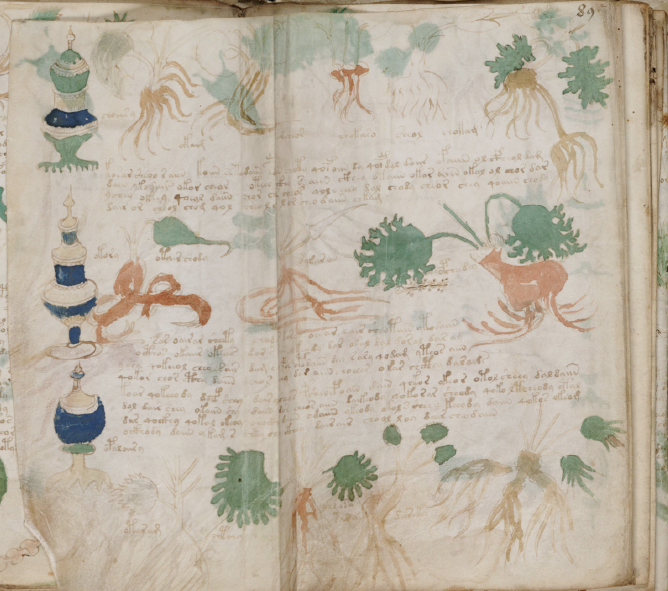
f89r1.15
[ORG] tcheol qoeair sheol qocphey saiin cheocphey dal darolm
[ACA]
-
tcheol = [VAR] relative bridge of the CHEOL/CHOTCHEOL type (“that which / with which”)
-
qoeair = operator QO- (operational reinjection / return to the cycle)
-
sheol = state of complete sealing (closed/solidified system)
-
qocphey = [VAR] QO- + CPHEY (execution/slot in the vessel under reinjection)
-
saiin = recorded/passive state (assumed/confirmed state)
-
cheocphey = pour/decant into the target vessel (clean transfer)
-
dal = genitive bridge of/from (provenance)
-
darolm = [UNK] (likely DAROL/AIROLM/TCHDAROL family: coupling/closure/sealant; low certainty)
[FUN]
Treat tcheol as a reference bridge (“what is in focus in the step”). Reinject the medium/flow into the cycle (qoeair) while keeping the system fully sealed (sheol). Execute the “in-vessel/slot” gesture under QO regime (qocphey) until the state becomes recorded/assumed (saiin). Then decant the fraction into the destination vessel (cheocphey), preserving the provenance mark (dal). darolm seems to qualify the apparatus closure/fit, but remains pending as a firm identification.
f89r1.16
[ORG] om sheey qokey l daiin dal chom chekechy chol cheos aiin dy
[ACA]
-
om = [MORF/UNK] isolated marker (compatible with a “portion/mass/mode -OM”, but not present as a standalone entry)
-
sheey = [SHE FAMILY/…EEY] active sealing/solidification (ongoing action)
-
qokey = operator QO- (reinjection/return to the active slot)
-
l = [L- PFX] nominal form/slot marker (appears as a prefix in the dictionary; here it appears “loose”)
-
daiin = fixed/settled state (D- family)
-
dal = of/from (provenance)
-
chom = base mixture / matrix compound
-
chekechy = quicklime / strong alkaline base (CHEK family)
-
chol = path/means/instrument/condition (“by means of…”)
-
cheos = [CHEO+S FAMILY…] fraction already poured/selected (e.g., CHEOSAIIN/CHEOSDY)
-
aiin = fixed/recorded state
-
dy = of/from (origin/belonging)
[FUN]
Take the portion (om) and keep active sealing (sheey) while executing operational reinjection into the slot (qokey). Bring the system to a settled state (daiin) and make the provenance explicit (dal). Work from the matrix mass (chom) by introducing quicklime (chekechy) through a means/instrument of the apparatus (chol). Use the already poured/clean fraction (cheos) and finish by recording/fixing the state (aiin), marking the origin relation again (dy).
f89r1.17
[ORG] qeaiin cheol seey qotey qokeeol daiin ykeedy daiin dam
[ACA]
-
qeaiin = [VAR] EAIIN-type state under Q- qualification (closure/fixation under reinjection regime; no exact “QEAIIN” entry)
-
cheol = relative bridge (CHEOL: “that which / which”)
-
seey = operator to keep in action / maintain incorporation in flow (avoid stasis)
-
qotey = [VAR/UNK] likely QOT- + -EY (closure command under QOT regime; no exact entry)
-
qokeeol = operator QO- (operational reinjection; return to the cycle/slot)
-
daiin = fixed/settled state
-
ykeedy = [VAR] chaining Y- + KEEDY (payload “KEEDY” = obtained extract/residue; “and then + product”)
-
daiin = fix again (second stabilization)
-
dam = [MORF/UNK] loose marker (the “-DAM” family appears in many tokens, but not as a standalone entry)
[FUN]
Set the procedure into a qualified fixation/closure state (qeaiin) and use cheol to bind the step’s referent. Keep the material in active incorporation (seey) and apply command-regime closure (qotey, likely variant). Return to the cycle with operational reinjection (qokeeol), stabilizing in daiin. Then add/incorporate the KEEDY payload as continuation of the chain (ykeedy) and fix again (daiin). The ending dam seems to close the step as a mode/result marker, but remains a pending morphological reading.
f89r1.18
[ORG] dals al dal cheody dainaldy al daldal
[ACA]
-
dals = saline fraction (salts present; adjust solubilization/decantation)
-
al = destination bridge (“to/into”)
-
dal = origin bridge (“of/from”)
-
cheody = [CHEO+DY FAMILY] pour/decant (e.g., DCHEODY/LCHEODY/OLCHEODY)
-
dainaldy = [COMP] DAIN + ALDY (reinforced provenance: “of/from + of/from”)
-
al = destination again
-
daldal = doubled origin (intentional provenance reinforcement)
[FUN]
Separate/treat the saline fraction (dals) and direct it to the step’s target (al), keeping provenance explicit (dal). Decant the fraction (cheody) without pulling sediment. Use dainaldy as reinforcement of “compound provenance” (origin tightly bound: from… of…), return to the destination (al), and finish by reinforcing the origin link with daldal (intentional duplication).
f89r1.19
[ORG] pshol sheo ?oaithy cheoepey s sheor qokair y dam daly
[ACA]
-
pshol = oil bath / oily medium (oleum)
-
sheo = sealing/solidification control (SHE-)
-
?oaithy = [SPECIAL CASE] [VAR] O- + AITHY (AITHY = item/condition-bridge; “O-” qualifies; “?” indicates genuine uncertainty)
-
cheoepey = pour/decant (clean transfer)
-
s = [MORF/UNK] isolated marker (likely plural/collective/emphasis; no “S” entry exists)
-
sheor = sealing/solidification control
-
qokair = [VAR] QO- + KAIR (“to which / referent” connector under QO regime; KAIR exists, QOKAIR does not)
-
y = chaining operator (Y-) in minimal form (no standalone “Y” entry)
-
dam = [MORF/UNK] loose mode/result marker
-
daly = genitive bridge “of/from (sealed)” (marked provenance)
[FUN]
Work in an oil bath (pshol) and maintain sealing control (sheo). The condition oaithy is a sensitive point: it functions as an “item/condition” qualified by O-, but the manuscript (and its “?” mark) demands caution—treat it as an operational condition of the step. Decant the fraction (cheoepey), possibly as a joint/collective action (s, pending), and reaffirm sealing (sheor). Use qokair to bind “to which/referent” inside the reinjection regime, chain the step (y), close the mode/result (dam, pending), and mark provenance as a sealed origin (daly).
f89r1.20
[ORG] daim cheom qoaikhy air cheody ldain dal chom chtaem
[ACA]
-
daim = [VAR] locative/interior (DYDAIM family = “from inside”; here “inside/in the interior”)
-
cheom = decant/transfer a fraction (transfer)
-
qoaikhy = [VAR] QO- + AIKHY (AIKHY = bridge/relative; QO- qualifies the chaining)
-
air = air/aeration medium (instrument/condition)
-
cheody = [CHEO+DY FAMILY] pour/decant
-
ldain = nominal state/closure (L-DAIN) (assumed/stabilized state)
-
dal = of/from
-
chom = matrix mass / base mixture
-
chtaem = thermal module (cook/heat / heat regime)
[FUN]
Inside the vessel (daim), perform a controlled transfer (cheom) and use qoaikhy as a qualified bridge (logical binding of the step under QO regime). Apply air/aeration (air) as a process condition and then decant (cheody). Stabilize into a nominal state (ldain), keeping the provenance mark (dal). Return to the matrix mass (chom) and apply the thermal regime (chtaem) as the point requires.
f89r1.21
[ORG] taiin dam shoety dal qokchy ykchdy otcham ol rchs aiin
[ACA]
-
taiin = [VAR] registration/fixation state (ETAIIN/LTAIIN/SOTAIIN families; pure “TAIIN” is not a listed entry)
-
dam = [MORF/UNK] mode/result marker
-
shoety = [VAR/UNK] likely family linked to OETY (in-use marker/closure) with SH- (sealing) qualification
-
dal = of/from (origin)
-
qokchy = QO- operator (operational reinjection; return to the cycle)
-
ykchdy = [VAR] chaining Y- + KCHDY (“and from here/at this point…”)
-
otcham = [VAR] CHAM family (measured dose/calibrated portion); QOTCHAM exists in the dictionary, here it appears without QOT-
-
ol = to/into the (destination)
-
rchs = [VAR/UNK] likely RCH + -S (RCH = jar/intermediate vessel; “-S” qualifies/collectivizes)
-
aiin = fixed/recorded state
[FUN]
Fix the step into a registration state (taiin) and treat dam as a mode/result closure of the subcycle (pending as a standalone form). Maintain operational closure (shoety, likely variant) and preserve the origin (dal). Perform operational reinjection (qokchy) and, from this point (ykchdy), introduce a calibrated dose (otcham). Direct it to the intermediate vessel (ol + rchs) and finish with a fixed state (aiin).
f89r1.22
[ORG] ysheeo r sheol qockhedy yty sheody qotol chead chey dal
[ACA]
-
ysheeo = SHE- control (sealing/solidification)
-
r = [UNK] isolated marker (may be an abbreviation/vessel index, but no “R” entry exists)
-
sheol = complete sealing (closed state)
-
qockhedy = [VAR] very likely QCKHEDY family (a “lime bath / agitation / hold until it clears or softens” step)
-
yty = continuity connector (“continue execution”)
-
sheody = [SHE FAMILY…] sealing/solidification (variant not registered as a standalone token)
-
qotol = operator introduce/dose the next component into the flow
-
chead = uncertain bridge (connector; unstable reading in the dictionary)
-
chey = [CHEY FAMILY] relative connector (“that/so that/to which…”, depends on affix)
-
dal = provenance of/from
[FUN]
Activate sealing control (ysheeo) and keep the system in complete sealing (sheol). The r is an isolated marker and remains pending (possible vessel index or micro-step tag). Execute qockhedy as a lime-bath procedure with agitation/clearing (read via QCKHEDY family). Proceed in continuity (yty), reaffirm sealing (sheody), and then dose/introduce the next component into the flow (qotol). Use chead/chey as syntactic bridges (with chead explicitly uncertain) and keep the origin mark (dal).
f89r1.23
[ORG] dain oteor cheody cheodain daiin<->chodaiin
[ACA]
-
dain = short genitive “of/from” (provenance)
-
oteor = [VAR] measure/qualifier of TEOR (concentration/strength/virtue) — OTEOROM/OTEORAR exist in the dictionary
-
cheody = [CHEO+DY FAMILY] decant/pour
-
cheodain = fraction already decanted (clean liquor/transferred fraction)
-
daiin<->chodaiin = alternative:
-
DAIIN = fixed/settled state (generic)
-
CHODAIIN = fix a flow regime in the conduit (stabilized flow, cleaned channel)
-
[FUN]
From the provenance (dain), verify/qualify the concentration (oteor) before advancing. Decant (cheody) and treat what was transferred as a fraction already clean/poured (cheodain). Finish by fixing the state—either as a generic fixation (DAIIN), or, stronger and more specific, as a stable flow regime in the conduit (CHODAIIN).
Final section: isolated commands
f89r1.24
[ORG] ykocfhy
[ACA] [VAR] chaining Y- + CFHY/TCFHY family (leaf/filter: “set up and let it run to pass clean”)
[FUN]
Set up the leaf/filter device (TCFHY/CFHY family) and let the liquor run through it to pass cleanly and without loss, preparing the flow for the next step.
f89r1.25
[ORG] saldam
[ACA] joining salt / metallic flux (flux)
[FUN]
Take the joining salt (SALDAM) and apply it as flux at the junction point; then proceed with fire as the step requires.
f89r1.26
[ORG] sydarary
[ACA] directional bridge with no secure equivalent (already marked as unstable in the dictionary)
[FUN]
Use SYDARARY only as a directional bridge in the protocol (destination/chaining binding), without forcing a semantic equivalent: it commands “how to proceed” more than “what the matter is.”
f89r1.27
[ORG] ydcphdy
[ACA] [VAR] Y- + CHCPHDY family (operator: “remove/consider from the vessel”)
[FUN]
In continuation (Y-), remove/consider from the vessel before the next action, as immediate preparation for the following step (take from the vessel, take from the contents, or operate “from the vessel”).