
Tradução Procedural — Fólio f75v
Linha f75v.1
[ORG] pchedar.opchedy.qokedy.opchedy.qopdy | dain.chetas.chcphhy.qotam
[ACA]
-
PCHEDAR → [DERIV] família PCHED (cocção/termotratamento) + AR (direção/encaixe)
-
OPCHEDY → [DERIV] OPCHED (cocção controlada) + -Y (ação em curso)
-
QOKEDY → [VAR] família QOKED- (no dicionário aparece como QOKEDAL/QOKEDAIIN; aqui sem correspondência literal)
-
QOPDY → [UNK] (família QOPD- existe no dicionário, mas não esta forma exata)
-
DAIN → ponte genitiva curta (“do/da; a partir de”)
-
CHETAS → token marcado no dicionário como “não atestado/variação/erro de segmentação”
-
CHCPHHY → operador de fecho/selagem do recipiente (variante prefixada CH-)
-
QOTAM → passo imperativo marcado (operador QOT- de ordenação/controle)
[FUN]
Inicie um ciclo de cocção controlada e mantenha o aquecimento no ponto indicado. Em seguida, execute a reinjeção/retorno ao slot operacional (mesmo recipiente/compartimento — não é geografia) e retome o aquecimento conforme o protocolo. Depois aplique o operador QOPD- (forma não estabilizada neste trecho), conectando “do/da etapa” ao bloco seguinte. Trate CHETAS como variação técnica (sem semântica confiável) e então vede/feche o recipiente (CHCPHHY). Finalize executando o passo marcado QOTAM, que sela a ordem/controle do sub-bloco.
Linha f75v.2
[ORG] s
[ACA] glifo isolado / marcador curto de bloco (sem mapeamento operacional confiável neste recorte)
[FUN] Trate como marcador estrutural (quebra/âncora visual do manuscrito). Não uso como comando.
Linha f75v.3
[ORG] sor.sheky.qokain.okal.dal.olchedy | daiin.chckhy.lkar.chckhy.rom
[ACA]
-
SOR → cabeçalho “sobre/tópico do bloco” (ponte estrutural)
-
SHEKY → selagem/fecho em regime (controle de fechamento ativo)
-
QOKAIN → reinjeção central ao núcleo do aparato (retorno ao ciclo)
-
OKAL → assentar/decantar por repouso (separar topo/fundo)
-
DAL → ponte “do/da” (contração)
-
OLCHEDY → cocção controlada (termotratamento no ponto)
-
DAIIN → estado fixado/assentado (condição estabilizada)
-
CHCKHY → checagem/controle recorrente (validar e ajustar)
-
LKAR → [UNK/ FAM] provável família “LKAR-” (no dicionário aparecem formas como LKARCHEES/LKARSHAR; aqui não há verbete exato)
-
ROM → [UNK] (sem verbete literal; existe como parte de compostos, mas não isolado)
[FUN]
Como cabeçalho do bloco, mantenha o sistema selado sob controle (SHEKY) e retorne o conteúdo ao núcleo do aparato (QOKAIN). Em seguida, deixe assentar/decantar (OKAL) e só então retome o fluxo “do/da etapa” (DAL) aplicando cocção controlada (OLCHEDY). Ao atingir estado fixado (DAIIN), execute checagem rigorosa (CHCKHY). O token LKAR deve ser tratado com cautela (família sugere material/condição técnica, mas não há forma literal aqui). Finalize com nova checagem e marque ROM como pendência (pode ser registro/rotulagem/estado, mas não está estável neste trecho).
Linha f75v.4
[ORG] l
[ACA] marcador curto de bloco (sem mapeamento seguro)
[FUN] Use como separador/âncora estrutural.
Linha f75v.5
[ORG] dl.shckhy.kain.olchey.qokain.daly.rd | dl.shedy.qoteedy.cthedy.loly
[ACA]
-
DL → dose/porção medida (aplicar pouca quantidade)
-
SHCKHY → [VAR] muito provável de SHCKHEY (processo ligado a manejo/lixiviação/controle de carga; forma literal difere)
-
KAIN → estado/objeto “qual/aquele” (marcador nominal/estado)
-
OLCHEY → conector de dobradiça (“com isso / ao que / pelo que”)
-
QOKAIN → reinjeção ao núcleo do ciclo
-
DALY → ponte “do/da” em forma controlada/selada
-
RD → matéria botânica “raiz (radix)” (payload)
-
SHEDY → selagem/fecho em regime
-
QOTEEDY → [DERIV] de QOTEE (pontuação/segmentação do fluxo marcado) + -DY (derivação)
-
CTHEDY → [UNK] (sem verbete literal; não dá pra “cravar” semântica aqui)
-
LOLY → retomada de objeto (“o/isso”) como ponte gramatical
[FUN]
Aplique uma dose pequena (DL) e conduza o sub-processo SHCKH- (forma variante neste trecho) sobre o estado/objeto KAIN. Use OLCHEY para encadear o gesto seguinte e reinjete ao núcleo (QOKAIN) “a partir do/da etapa” (DALY), introduzindo raiz botânica (RD) conforme a receita. Na metade direita, aplique novamente dose (DL), mantenha selagem ativa (SHEDY) e use QOTEE- como marcador de segmentação/ordem de fluxo (aqui em forma derivada). CTHEDY permanece pendente (não estabilizado). LOLY fecha retomando “o/isso” como objeto do passo.
Linha f75v.6
[ORG] l
[ACA] marcador curto de bloco
[FUN] separador estrutural.
Linha f75v.7
[ORG] qokchdy.qokal.dal.ol.chety.lchdy | csedy.ched.otedy.qotedy.otar
[ACA]
-
QOKCHDY → derivado da família QOK- (cocção/termotratamento qualificado)
-
QOKAL → [UNK/FAM] (família QOKAL- existe em formas maiores; aqui sem verbete literal)
-
DAL → “do/da” (ponte de origem)
-
OL → “ao/para o” (ponte de direção)
-
CHETY → “estes itens” (deíxis plural: operar sobre o conjunto)
-
LCHDY → [AMB] (pode ser derivação de LCH “o que/aquilo que” ou família LCHD-; forma literal não consta)
-
CSEDY → operar sobre o sedimento (gestão do fundo)
-
CHED → cocção controlada (aplicar calor)
-
OTEDY → [DERIV] de OTED (passar pela tela/pano) + -Y
-
QOTEDY → [DERIV/UNK] (forma QOTED- existe no dicionário com sufixos; aqui sem verbete literal)
-
OTAR → [DERIV] família TAR (tara/calibração de medida); forma mais próxima no dicionário é OTARO/OTARD…
[FUN]
Aplique uma cocção qualificada (QOKCHDY) e realize o retorno/estabilização QOKAL- (forma de família, não literal aqui). Conecte “do/da etapa” (DAL) e direcione (OL) o trabalho para estes itens (CHETY), com LCHDY funcionando como ponte (forma ambígua neste trecho). Na metade direita, trabalhe o sedimento (CSEDY), aplique cocção (CHED), passe o preparado pela tela/pano (OTEDY) e então execute a etapa QOTED- como reinjeção/ordenação do fluxo (forma não estabilizada). Conclua com calibração/tara (OTAR-) para manter medida reprodutível.
Linha f75v.8
[ORG] o
[ACA] marcador curto de bloco
[FUN] separador estrutural.
Linha f75v.9
[ORG] r
[ACA] marcador curto de bloco
[FUN] separador estrutural.
Linha f75v.10
[ORG] qokeed.chedy.ky.okedy.lchedy.dar.ody | dchedy.dar.olchedy.otedy.qoky
[ACA]
-
QOKEED → [VAR] muito próximo de QOKEEOD/QOKEEODY (reinjeção operacional; forma do manuscrito diverge)
-
CHEDY → [DERIV] CHED + -Y (cocção em curso)
-
KY → trabalhar o lote (ação física controlada: mexer/moer/agir)
-
OKEDY → slot operacional/âncora interna (referência ao mesmo compartimento)
-
LCHEDY → cocção controlada (forma L-)
-
DAR → passo “dare” (ato de dar/aplicar/transferir conforme contexto)
-
ODY → [UNK] (sem verbete literal)
-
DCHEDY → [DERIV] DCHED + -Y (cocção controlada em variante D-)
-
OLCHEDY → cocção controlada no ponto (OL-)
-
OTEDY → filtração por tela/pano em curso
-
QOKY → reinjeção operacional (retorno ao ciclo/slot)
[FUN]
Execute a reinjeção operacional QOKEE- (forma variante aqui) e mantenha a cocção em curso (CHEDY) enquanto trabalha o lote (KY). Use OKEDY para ancorar o encadeamento no slot interno e aplique nova cocção (LCHEDY). Em seguida, realize o passo DAR (dar/aplicar/transferir), mantendo ODY como pendência (pode ser qualificador de estado/objeto, mas não está definido). Na metade direita, execute cocção D- (DCHEDY), prossiga com DAR, aplique cocção OL- (OLCHEDY), filtre pela tela (OTEDY) e finalize reinjetando no ciclo (QOKY).
Linha f75v.11
[ORG] s
[ACA] marcador curto de bloco
[FUN] separador estrutural.
Linha f75v.12
[ORG] qokedy.rshey.qol.chey.ol.chey.keed | sol.key.dykedy.qokol.dar.oly
[ACA]
-
QOKEDY → [VAR] família QOKED- (slot/reinjeção; sem forma literal)
-
RSHEY → [DERIV] de RSHE (selagem/controle SHE-) + -Y
-
QOL → [UNK/FAM] (há formas QOL- no dicionário, mas não “QOL” isolado)
-
CHEY → [UNK/FAM] (há família CHEY- em múltiplas formas; não isolado)
-
OL → direção (“ao/para o”)
-
KEED → payload/nominal candidato (matéria/produto do passo)
-
SOL → meio/solvente/solução base (instrumento do protocolo)
-
KEY → [UNK]
-
DYKEDY → ponte “daqui/deste ponto” (origem/pertencimento)
-
QOKOL → [UNK/VAR] muito próximo de QOKOLY/QOKOLD… (reinjeção operacional na família)
-
DAR → passo operacional
-
OLY → [DERIV] provável de OL (direção) + -Y (forma não literal)
[FUN]
Reinjete no slot (QOKED-, forma variante) e mantenha o bloco sob controle de selagem (RSHE-). Use QOL/CHEY como conectores de alvo/encadeamento (pendentes em forma isolada), direcione (OL) e introduza/retome KEED como carga do passo. Na metade direita, opere sob meio SOL, execute KEY (pendente), marque a origem “daqui” (DYKEDY), realize reinjeção QOKOL- (forma variante) e então execute DAR direcionando ao destino (OL- em forma derivada).
Linha f75v.13
[ORG] ocheain.cheedy.qokal.dain.sheeky.qoky | sshedy.tedy.otedy.tedy.taral
[ACA]
-
OCHEAIN → estado/preparo “não identificado” (estabilizar e observar antes de avançar)
-
CHEEDY → “faz/aplica/executa” em curso (ponte operativa)
-
QOKAL → [UNK/FAM] (família QOKAL-; sem forma literal isolada)
-
DAIN → “do/da” (ponte)
-
SHEEKY → [VAR] família SHEE/SHEEK- (controle/selagem; forma literal não aparece)
-
QOKY → reinjeção operacional
-
SSHEDY → selagem em curso (derivado de SHE-)
-
TEDY → tela/pano de filtração (instrumento)
-
OTEDY → passar pela tela/pano (filtrar) em curso
-
TARAL → porção ajustada/calibrada (carga já “na conta”)
[FUN]
Mantenha o sistema no estado OCHEAIN (preparo/extrato ainda não rotulado), execute a ação CHEEDY e aplique o retorno QOKAL- (forma de família). Conecte “do/da etapa” (DAIN), mantenha SHEE/SHEEK- como controle de fechamento (forma variante) e reinjete no ciclo (QOKY). Na metade direita, mantenha a selagem ativa (SSHEDY) e conduza o material por filtração (TEDY/OTEDY/TEDY) até obter a porção TARAL já ajustada/calibrada.
Linha f75v.14
[ORG] qol.sheckhy.qokedy.qokedy.qokaly | sor.chedy.qoky.olshty.qokydy
[ACA]
-
QOL → [UNK/FAM] (base isolada não estabilizada)
-
SHECKHY → [VAR] de SHECKH (controle/selagem)
-
QOKEDY (x2) → [VAR] reinjeção/slot (dupla passagem = reforço operacional)
-
QOKALY → [VAR/DERIV] QOKAL- + -Y (forma não literal)
-
SOR → cabeçalho do bloco
-
CHEDY → cocção em curso (derivação de CHED)
-
QOKY → reinjeção operacional
-
OLSHTY → [UNK] (possível variante próxima de família OLSHED/SHE-, mas sem verbete literal)
-
QOKYDY → [DERIV/UNK] QOKY + -DY (forma não literal)
[FUN]
Sob o conector QOL (pendente), aplique controle de selagem SHECKH- (variante). Execute reinjeção em slot duas vezes (QOKEDY.QOKEDY) como reforço do ciclo e estabilize o retorno QOKAL- (forma derivada). No cabeçalho seguinte (SOR), mantenha cocção em curso (CHEDY) e reinjete (QOKY). Trate OLSHTY como pendência (provável “selagem concluída/fecho”, mas não está estabilizado) e finalize com a derivação QOKYDY como fechamento de retorno.
Linha f75v.15
[ORG] ral.ol.oloin.olkey.olshed.qokaly | qokar.chedy.qokain.ty.lshdyqo
[ACA]
-
RAL → [FAM/UNK] família RAL- aparece como reagente/aditivo (RALOM/RALDL/RALCHL), mas não isolado
-
OL → direção (“ao/para o”)
-
OLOIN → candidato nominal/qualificador (não rotulado)
-
OLKEY → [VAR] muito provável de OLKEEY (apontador/âncora de referência)
-
OLSHED → controle/selagem (família SHE-)
-
QOKALY → [VAR] retorno/reinjeção (forma não literal)
-
QOKAR → reinjeção seletiva (seleciona o alvo “qual” e reinsere no ciclo)
-
CHEDY → cocção em curso
-
QOKAIN → retorno ao núcleo
-
TY → [UNK]
-
LSHDYQO → “etapa de selagem (subpasso)” (passo operacional de fecho)
[FUN]
Introduza RAL- como carga/reagente (família indica aditivo/clarificante/corretivo, mas a forma isolada é pendente), direcione (OL) ao qualificador OLOIN e use OLKEY como apontador de referência do bloco. Mantenha selagem (OLSHED) e execute o retorno QOKAL- (forma variante). Na metade direita, faça reinjeção seletiva (QOKAR), mantenha cocção em curso (CHEDY), retorne ao núcleo (QOKAIN), trate TY como pendência e execute o subpasso explícito de selagem (LSHDYQO).
Linha f75v.16
[ORG] odchedy.qolshdy.shokshdy.qokain | or.shedy.qolol.keedy.qokalom
[ACA]
-
ODCHEDY → cocção/termotratamento (forma OD-)
-
QOLSHDY → [UNK] (sem verbete literal; não vou inventar)
-
SHOKSHDY → ajuste de parâmetro/alvo sob módulo de controle (qualificador técnico)
-
QOKAIN → retorno ao núcleo do ciclo
-
OR → ponte de ligação (no dicionário funciona como articulação/ponte)
-
SHEDY → selagem em curso
-
QOLOL → porção oleosa (fase/veículo em óleo)
-
KEEDY → derivado de KEE/KEED (produto/porção “de aqui”, carga do passo)
-
QOKALOM → reinjeção operacional (forma QOKAL-OM)
[FUN]
Aplique termotratamento (ODCHEDY) e mantenha QOLSHDY como pendência estrutural do bloco. Use SHOKSHDY para ajustar parâmetro/condição do módulo sob controle e retorne ao núcleo (QOKAIN). Em seguida, conecte (OR), mantenha selagem ativa (SHEDY), introduza a porção oleosa (QOLOL), aplique a carga KEEDY e finalize com reinjeção operacional QOKALOM para fechar o ciclo.
Linha f75v.17
[ORG] sal.shedykain.qokain.sheckhy.ld | saiin.ckhy.lshedy<$>
[ACA]
-
SAL → reagente salino base
-
SHEDYKAIN → [COMP/UNK] composição provável SHEDY + KAIN (selagem aplicada ao estado/objeto), mas não há verbete literal
-
QOKAIN → retorno ao núcleo
-
SHECKHY → [VAR] de SHECKH (controle/selagem)
-
LD → ponte genitiva curta (“do/da”)
-
SAIIN → estado de pureza/registro/“puro/assentado”
-
CKHY → controle/inspeção (validação local)
-
LSHEDY → selagem em curso (variante L-)
-
<$>→ fechamento de bloco
[FUN]
Introduza SAL como reagente base. Aplique selagem sobre o estado/objeto (SHEDY+KAIN, aqui como composição provável), retorne o conteúdo ao núcleo (QOKAIN) e realize checagem/controle (SHECKH-, variante). Use LD como ponte “do/da etapa”. Confirme o estado SAIIN (pureza/registro atingido), execute inspeção (CKHY) e finalize com selagem (LSHEDY), encerrando o bloco <$>.
Síntese do que este trecho faz (sem forçar semântica além do dicionário)
O f75v, nesse recorte, se comporta como um loop procedural com:
-
ciclos de cocção/termotratamento (CHED / DCHED / OLCHED / ODCHED + formas em -Y),
-
retornos e reinjeções (QOKAIN, QOKY, família QOKED-/QOKAL-),
-
gestão de estado por repouso/decantação (OKAL, DAIIN/-AIIN),
-
checagem/controle recorrente (CHCKHY/CKHY),
-
filtração explícita por tela/pano (TEDY/OTED/OTEDY),
-
e selagem/fechos em múltiplas camadas (SHE-, SHEDY, OLSHED, LSHDYQO).
Isso é exatamente o tipo de “texto que parece executável”: não conta história, orquestra operações, alternando passos, estados, checagens, meios, e retornos ao mesmo recipiente.
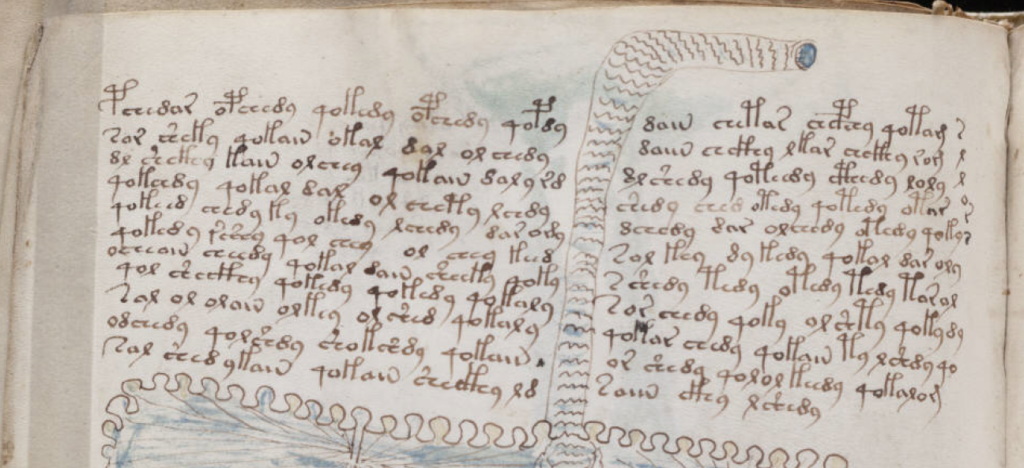
<f75v.1,@P0> <%>pchedar.opchedy.qokedy.opchedy.qopdy<->dain.chetas.chcphhy.qotam
<f75v.2,=L0> s
<f75v.3,*P0> sor.sheky.qokain.okal.dal.olchedy<->daiin.chckhy.lkar.chckhy.rom
<f75v.4,=L0> l
<f75v.5,*P0> dl.shckhy.kain.olchey.qokain.daly.rd<->dl.shedy.qoteedy.cthedy.loly
<f75v.6,=L0> l
<f75v.7,*P0> qokchdy.qokal.dal.ol.chety.lchdy<->csedy.ched.otedy.qotedy.otar
<f75v.8,~L0> o
<f75v.9,+L0> r
<f75v.10,*P0> qokeed.chedy.ky.okedy.lchedy.dar.ody<->dchedy.dar.olchedy.otedy.qoky
<f75v.11,=L0> s
<f75v.12,*P0> qokedy.rshey.qol.chey.ol.chey.keed<->sol.key.dykedy.qokol.dar.oly
<f75v.13,+P0> ocheain.cheedy.qokal.dain.sheeky.qoky<->sshedy.tedy.otedy.tedy.taral
<f75v.14,+P0> qol.sheckhy.qokedy.qokedy.qokaly<->sor.chedy.qoky.olshty.qokydy
<f75v.15,+P0> ral.ol.oloin.olkey.olshed.qokaly<->qokar.chedy.qokain.ty.lshdyqo
<f75v.16,+P0> odchedy.qolshdy.shokshdy.qokain<->or.shedy.qolol.keedy.qokalom
<f75v.17,+P0> sal.shedykain.qokain.sheckhy.ld<->saiin.ckhy.lshedy<$>
Procedural Translation — Folio f75v
Line f75v.1
[ORG] pchedar.opchedy.qokedy.opchedy.qopdy | dain.chetas.chcphhy.qotam
[ACA]
-
PCHEDAR → [DERIV] PCHED family (cooking/thermal treatment) + AR (direction/fit)
-
OPCHEDY → [DERIV] OPCHED (controlled cooking) + -Y (ongoing action)
-
QOKEDY → [VAR] QOKED- family (in the dictionary it appears as QOKEDAL/QOKEDAIIN; here without a literal match)
-
QOPDY → [UNK] (the QOPD- family exists in the dictionary, but not this exact form)
-
DAIN → short genitive bridge (“of/from”)
-
CHETAS → token flagged in the dictionary as “unattested/variant/segmentation error”
-
CHCPHHY → container closure/sealing operator (CH- prefixed variant)
-
QOTAM → marked imperative step (QOT- ordering/control operator)
[FUN]
Initiate a controlled cooking cycle and keep heating at the indicated point. Then execute the re-injection/return to the operational slot (same vessel/compartment—this is not geography) and resume heating per protocol. After that, apply the QOPD- operator (form not stabilized in this passage), linking “from/of the step” to the next block. Treat CHETAS as a technical variant (no reliable semantics), then seal/close the container (CHCPHHY). Finish by executing the marked step QOTAM, which seals the order/control of the sub-block.
Line f75v.2
[ORG] s
[ACA] isolated glyph / short block marker (no reliable operational mapping in this excerpt)
[FUN] Treat as a structural marker (visual break/anchor in the manuscript). I do not use it as a command.
Line f75v.3
[ORG] sor.sheky.qokain.okal.dal.olchedy | daiin.chckhy.lkar.chckhy.rom
[ACA]
-
SOR → block header “on/about / topic of the block” (structural bridge)
-
SHEKY → sealing/closure under regimen (active closure control)
-
QOKAIN → central re-injection to the core of the apparatus (return to the cycle)
-
OKAL → settle/decant by resting (separate top/bottom)
-
DAL → “of/from” bridge (contraction)
-
OLCHEDY → controlled cooking (thermal treatment at the set point)
-
DAIIN → fixed/settled state (stabilized condition)
-
CHCKHY → recurring check/control (validate and adjust)
-
LKAR → [UNK/ FAM] probable “LKAR-” family (the dictionary has forms like LKARCHEES/LKARSHAR; here there is no exact entry)
-
ROM → [UNK] (no literal entry; it exists as part of compounds, but not standalone)
[FUN]
As the block header, keep the system sealed under control (SHEKY) and return the contents to the apparatus core (QOKAIN). Next, let it settle/decant (OKAL), and only then resume the “of/from the step” flow (DAL) by applying controlled cooking (OLCHEDY). Upon reaching a fixed state (DAIIN), execute a strict check (CHCKHY). The token LKAR should be treated cautiously (the family suggests a material/technical condition, but there is no literal form here). Finish with a new check and mark ROM as pending (it may be record/labeling/state, but it is not stable in this passage).
Line f75v.4
[ORG] l
[ACA] short block marker (no safe mapping)
[FUN] Use as a separator/structural anchor.
Line f75v.5
[ORG] dl.shckhy.kain.olchey.qokain.daly.rd | dl.shedy.qoteedy.cthedy.loly
[ACA]
-
DL → measured dose/portion (apply a small quantity)
-
SHCKHY → [VAR] very likely from SHCKHEY (process tied to handling/leaching/load control; literal form differs)
-
KAIN → state/object “which/that” (nominal/state marker)
-
OLCHEY → hinge connector (“with that / to which / by which”)
-
QOKAIN → re-injection to the cycle core
-
DALY → “of/from” bridge in a controlled/sealed form
-
RD → botanical material “root (radix)” (payload)
-
SHEDY → sealing/closure under regimen
-
QOTEEDY → [DERIV] from QOTEE (marked flow punctuation/segmentation) + -DY (derivation)
-
CTHEDY → [UNK] (no literal entry; semantics cannot be nailed down here)
-
LOLY → object resumption (“it/that”) as a grammatical bridge
[FUN]
Apply a small dose (DL) and run the SHCKH- sub-process (variant form in this passage) over the KAIN state/object. Use OLCHEY to chain the next gesture and reinject to the core (QOKAIN) “from/of the step” (DALY), introducing botanical root (RD) per the recipe. On the right half, apply dose (DL) again, keep active sealing (SHEDY), and use QOTEE- as a flow order/segmentation marker (here in derived form). CTHEDY remains pending (not stabilized). LOLY closes by resuming “it/that” as the step’s object.
Line f75v.6
[ORG] l
[ACA] short block marker
[FUN] structural separator.
Line f75v.7
[ORG] qokchdy.qokal.dal.ol.chety.lchdy | csedy.ched.otedy.qotedy.otar
[ACA]
-
QOKCHDY → derived from the QOK- family (qualified cooking/thermal treatment)
-
QOKAL → [UNK/FAM] (the QOKAL- family exists in longer forms; here no literal entry)
-
DAL → “of/from” (origin bridge)
-
OL → “to/for the” (direction bridge)
-
CHETY → “these items” (plural deixis: operate on the set)
-
LCHDY → [AMB] (may be a derivation of LCH “what/that which” or the LCHD- family; literal form not attested)
-
CSEDY → operate on the sediment (bottom management)
-
CHED → controlled cooking (apply heat)
-
OTEDY → [DERIV] from OTED (pass through cloth/screen) + -Y
-
QOTEDY → [DERIV/UNK] (the QOTED- form exists in the dictionary with suffixes; here no literal entry)
-
OTAR → [DERIV] TAR family (tare/calibration of measure); the closest dictionary form is OTARO/OTARD…
[FUN]
Apply qualified cooking (QOKCHDY) and perform the return/stabilization QOKAL- (family form, not literal here). Link “of/from the step” (DAL) and direct (OL) the work toward these items (CHETY), with LCHDY acting as a bridge (ambiguous form in this passage). On the right half, work the sediment (CSEDY), apply cooking (CHED), pass the preparation through cloth/screen (OTEDY), and then execute the QOTED- step as a flow reinjection/ordering move (form not stabilized). Conclude with calibration/tare (OTAR-) to keep the measure reproducible.
Line f75v.8
[ORG] o
[ACA] short block marker
[FUN] structural separator.
Line f75v.9
[ORG] r
[ACA] short block marker
[FUN] structural separator.
Line f75v.10
[ORG] qokeed.chedy.ky.okedy.lchedy.dar.ody | dchedy.dar.olchedy.otedy.qoky
[ACA]
-
QOKEED → [VAR] very close to QOKEEOD/QOKEEODY (operational re-injection; manuscript form diverges)
-
CHEDY → [DERIV] CHED + -Y (cooking in progress)
-
KY → work the batch (controlled physical action: stir/grind/act)
-
OKEDY → operational slot / internal anchor (reference to the same compartment)
-
LCHEDY → controlled cooking (L- form)
-
DAR → “dare” step (act of giving/applying/transferring depending on context)
-
ODY → [UNK] (no literal entry)
-
DCHEDY → [DERIV] DCHED + -Y (controlled cooking, D- variant)
-
OLCHEDY → controlled cooking at the set point (OL-)
-
OTEDY → cloth/screen filtration in progress
-
QOKY → operational re-injection (return to the cycle/slot)
[FUN]
Execute the operational re-injection QOKEE- (variant form here) and keep cooking in progress (CHEDY) while working the batch (KY). Use OKEDY to anchor the chain in the internal slot and apply another cooking step (LCHEDY). Next, perform the DAR step (give/apply/transfer), keeping ODY as pending (it may qualify a state/object, but it is not defined). On the right half, execute D- cooking (DCHEDY), proceed with DAR, apply OL- cooking (OLCHEDY), filter through cloth/screen (OTEDY), and finish by reinjecting into the cycle (QOKY).
Line f75v.11
[ORG] s
[ACA] short block marker
[FUN] structural separator.
Line f75v.12
[ORG] qokedy.rshey.qol.chey.ol.chey.keed | sol.key.dykedy.qokol.dar.oly
[ACA]
-
QOKEDY → [VAR] QOKED- family (slot/re-injection; no literal form)
-
RSHEY → [DERIV] from RSHE (SHE- sealing/control) + -Y
-
QOL → [UNK/FAM] (QOL- forms exist in the dictionary, but not standalone “QOL”)
-
CHEY → [UNK/FAM] (CHEY- family exists in multiple forms; not standalone)
-
OL → direction (“to/for”)
-
KEED → payload / candidate nominal (material/product of the step)
-
SOL → medium/solvent/base solution (protocol instrument)
-
KEY → [UNK]
-
DYKEDY → “from here/at this point” bridge (origin/belonging)
-
QOKOL → [UNK/VAR] very close to QOKOLY/QOKOLD… (family-form operational reinjection)
-
DAR → operational step
-
OLY → [DERIV] likely from OL (direction) + -Y (non-literal form)
[FUN]
Reinject into the slot (QOKED-, variant form) and keep the block under sealing control (RSHE-). Use QOL/CHEY as target/chaining connectors (pending in standalone form), direct (OL), and introduce/resume KEED as the step’s load. On the right half, operate under SOL medium, execute KEY (pending), mark the “from here” origin (DYKEDY), perform QOKOL- reinjection (variant form), and then execute DAR, directing to the destination (OL- in derived form).
Line f75v.13
[ORG] ocheain.cheedy.qokal.dain.sheeky.qoky | sshedy.tedy.otedy.tedy.taral
[ACA]
-
OCHEAIN → “unidentified” state/prep (stabilize and observe before advancing)
-
CHEEDY → “does/applies/executes” in progress (operative bridge)
-
QOKAL → [UNK/FAM] (QOKAL- family; no standalone literal form)
-
DAIN → “of/from” (bridge)
-
SHEEKY → [VAR] SHEE/SHEEK- family (control/sealing; literal form does not appear)
-
QOKY → operational reinjection
-
SSHEDY → sealing in progress (derived from SHE-)
-
TEDY → cloth/screen for filtration (instrument)
-
OTEDY → pass through cloth/screen (filter) in progress
-
TARAL → adjusted/calibrated portion (load already “counted out”)
[FUN]
Keep the system in the OCHEAIN state (prep/extract not yet labeled), execute CHEEDY, and apply the QOKAL- return (family form). Link “of/from the step” (DAIN), keep SHEE/SHEEK- as closure control (variant form), and reinject into the cycle (QOKY). On the right half, maintain active sealing (SSHEDY) and carry the material through filtration (TEDY/OTEDY/TEDY) until reaching the already adjusted/calibrated portion TARAL.
Line f75v.14
[ORG] qol.sheckhy.qokedy.qokedy.qokaly | sor.chedy.qoky.olshty.qokydy
[ACA]
-
QOL → [UNK/FAM] (unstabilized standalone base)
-
SHECKHY → [VAR] from SHECKH (control/sealing)
-
QOKEDY (x2) → [VAR] re-injection/slot (double pass = operational reinforcement)
-
QOKALY → [VAR/DERIV] QOKAL- + -Y (non-literal form)
-
SOR → block header
-
CHEDY → cooking in progress (derived from CHED)
-
QOKY → operational reinjection
-
OLSHTY → [UNK] (possible variant near the OLSHED/SHE- family, but no literal entry)
-
QOKYDY → [DERIV/UNK] QOKY + -DY (non-literal form)
[FUN]
Under the QOL connector (pending), apply SHECKH- sealing control (variant). Execute slot reinjection twice (QOKEDY.QOKEDY) as cycle reinforcement and stabilize the return QOKAL- (derived form). In the next header (SOR), keep cooking in progress (CHEDY) and reinject (QOKY). Treat OLSHTY as pending (likely “sealing completed/closure,” but not stabilized) and finish with the QOKYDY derivation as return closure.
Line f75v.15
[ORG] ral.ol.oloin.olkey.olshed.qokaly | qokar.chedy.qokain.ty.lshdyqo
[ACA]
-
RAL → [FAM/UNK] the RAL- family appears as reagent/additive (RALOM/RALDL/RALCHL), but not standalone
-
OL → direction (“to/for”)
-
OLOIN → candidate nominal/qualifier (unlabeled)
-
OLKEY → [VAR] very likely OLKEEY (reference pointer/anchor)
-
OLSHED → control/sealing (SHE- family)
-
QOKALY → [VAR] return/reinjection (non-literal form)
-
QOKAR → selective reinjection (selects the “which” target and reinserts it into the cycle)
-
CHEDY → cooking in progress
-
QOKAIN → return to the core
-
TY → [UNK]
-
LSHDYQO → “sealing step (sub-step)” (explicit closure operation)
[FUN]
Introduce RAL- as the load/reagent (family suggests additive/clarifier/corrective, but the standalone form is pending), direct (OL) to the OLOIN qualifier, and use OLKEY as a reference pointer for the block. Maintain sealing (OLSHED) and execute the QOKAL- return (variant form). On the right half, perform selective reinjection (QOKAR), keep cooking in progress (CHEDY), return to the core (QOKAIN), treat TY as pending, and execute the explicit sealing sub-step (LSHDYQO).
Line f75v.16
[ORG] odchedy.qolshdy.shokshdy.qokain | or.shedy.qolol.keedy.qokalom
[ACA]
-
ODCHEDY → cooking/thermal treatment (OD- form)
-
QOLSHDY → [UNK] (no literal entry; I won’t invent one)
-
SHOKSHDY → parameter/target adjustment under a control module (technical qualifier)
-
QOKAIN → return to the cycle core
-
OR → linking bridge (in the dictionary it functions as an articulation/bridge)
-
SHEDY → sealing in progress
-
QOLOL → oily portion (phase/oil vehicle)
-
KEEDY → derived from KEE/KEED (product/portion “from here,” step load)
-
QOKALOM → operational reinjection (QOKAL-OM form)
[FUN]
Apply thermal treatment (ODCHEDY) and keep QOLSHDY as a pending structural element of the block. Use SHOKSHDY to adjust the module’s parameter/condition under control, and return to the core (QOKAIN). Then link (OR), maintain active sealing (SHEDY), introduce the oily portion (QOLOL), apply the KEEDY load, and finish with QOKALOM operational reinjection to close the cycle.
Line f75v.17
[ORG] sal.shedykain.qokain.sheckhy.ld | saiin.ckhy.lshedy<$>
[ACA]
-
SAL → base saline reagent
-
SHEDYKAIN → [COMP/UNK] probable composition SHEDY + KAIN (sealing applied to the state/object), but no literal entry exists
-
QOKAIN → return to the core
-
SHECKHY → [VAR] from SHECKH (control/sealing)
-
LD → short genitive bridge (“of/from”)
-
SAIIN → purity/record state (“pure/settled”)
-
CKHY → control/inspection (local validation)
-
LSHEDY → sealing in progress (L- variant)
-
<$>→ block closure
[FUN]
Introduce SAL as the base reagent. Apply sealing over the state/object (SHEDY+KAIN, here as a probable composition), return the contents to the core (QOKAIN), and perform checking/control (SHECKH-, variant). Use LD as the “of/from the step” bridge. Confirm the SAIIN state (purity/record achieved), run inspection (CKHY), and finish with sealing (LSHEDY), closing the block with <$>.
Synthesis of what this excerpt does (without forcing semantics beyond the dictionary)
In this excerpt, f75v behaves like a procedural loop with:
-
cooking/thermal-treatment cycles (CHED / DCHED / OLCHED / ODCHED + -Y forms),
-
returns and reinjections (QOKAIN, QOKY, QOKED-/QOKAL- family),
-
state management via rest/decantation (OKAL, DAIIN/-AIIN),
-
recurring checking/control (CHCKHY/CKHY),
-
explicit cloth/screen filtration (TEDY/OTED/OTEDY),
-
and multi-layer sealing/closures (SHE-, SHEDY, OLSHED, LSHDYQO).
That is exactly the kind of “text that looks executable”: it does not tell a story—it orchestrates operations, alternating steps, states, checks, media, and returns to the same vessel.