
RESULTADO DE ANÁLISE
Linha f36r.1
[ORG] pchafdan.qorain.chcfhal.soiin.cphor.shaiin.cthy.dair
[ACA]
-
pchafdan = carga/material: fluxo salino reativo (mistura de fundição; “flux”)
-
qorain = QOR + -AIN (derivado; sem verbete exato) → “acoplamento/interface em estado fixado”
-
chcfhal = conector demonstrativo procedural (“sobre isto / neste ponto”)
-
soiin = ponte preposicional (“sobre os / nos”)
-
cphor = CPHO (vaso/recipiente) + variação final (derivado; sem verbete exato)
-
shaiin = estado concluído: selado e fixado
-
cthy = ponte de transição (“amarra subpasso → passo seguinte”)
-
dair = fração: licor claro (fase aquosa clarificada)
[FUN]
Introduza PCHAFDAN como carga do lote (fluxo salino reativo), usando-o quando o banho pede “limpeza” e melhor corrida do processo. Em seguida, execute o acoplamento direcional (QOR) e considere-o fixado (-AIN) antes de avançar. Neste ponto, trabalhe sobre/no(s) recipiente(s) de contenção (família CPHO) e leve o conjunto ao estado selado e fixado (SHAIIN). Faça a ponte de transição (CTHY) e integre a fração aquosa: recolha/incorpore o licor claro (DAIR) conforme a sequência do protocolo.
Notas críticas (rigor):
-
qorain não existe como verbete “puro” nesta versão; a leitura vem de QOR (acoplar) + sufixo -AIN (estado). Isso é reconstrução morfológica, não “palavra provada”.
-
cphor é tratado como variante do recipiente CPHO (alta confiança), com final -R como variação gráfica/aglutinada.
Linha f36r.2
[ORG] oral.shor.ytaiin.qotaiin.qooldy.chty.chol.dy.tor
[ACA]
-
oral = marcador deíctico/posicional (“agora aqui/ali”) (derivado de ORALY/ORALD; sem verbete exato)
-
shor = abrir/soltar (romper selo / liberar passagem; ventilação)
-
ytaiin = Y + (TAIIN) (derivado; sem verbete exato) → “e então: estado fixado/registrado” (marcador de estabilização)
-
qotaiin = QOT + -AIIN (derivado; sem verbete exato) → “ação-núcleo QOT em estado fixado/registrado”
-
qooldy = variante de QO- + OLDY (derivado; aproxima de QOKOLDY) → reinjeção/controle sobre o slot óleo (OLDY)
-
chty = manter aquecimento/cozedura (regime térmico contínuo)
-
chol = ponte instrumental (“com/por meio de…”)
-
dy = ponte preposicional (“de/do/da”)
-
tor = matéria/reagente nomeado (“TOR” como carga sólida do inventário)
[FUN]
Marque o ponto (“ora aqui/ali”) e abra/solte para permitir passagem/ventilação (SHOR). Em seguida, faça o sistema entrar em estabilização registrada (-AIIN), e trate o núcleo QOT como fixado (QOT-AIIN) antes de continuar. Aplique o controle de ciclo QO- sobre o óleo (OLDY) — isto é, opere a reinjeção/controle do meio oleoso conforme o contexto. Mantenha o regime térmico ativo (CHTY) e execute o passo por meio do instrumento/meio indicado (CHOL), conectando “de/do/da” (DY) ao reagente/carga TOR, que entra como matéria do preparo.
Notas críticas (rigor):
-
ytaiin / qotaiin / qooldy / oral são leituras por derivação, não por verbete exato. O núcleo forte aqui é: SHOR (controle de abertura), CHTY (calor mantido), CHOL (instrumental), DY (genitivo/ligação) e TOR (matéria nomeada) — estes têm sustentação direta no léxico.
Linha f36r.3
[ORG] qotchy.tchy.daiin.gaiin.dolsain
[ACA]
-
qotchy = QOT + CHY (derivado; sem verbete exato) → “aplicar o núcleo QOT ao alvo selecionado”
-
tchy = núcleo de “interface/acoplador” (derivado; relacionado a YTCHY como ponte de interface)
-
daiin = estado fixado/assentado (família D-)
-
gaiin = estado fixado/assentado (família G-)
-
dolsain = estado concluído “da marca/do sinal” (del segno / della marca)
[FUN]
Aplique o núcleo operativo QOT direcionado a um alvo selecionado (-CHY), usando o acoplador de interface (TCHY) para “encaixar” o subpasso no fluxo principal. Em seguida, declare/registre o sistema em estado fixado (DAIIN) e depois em estado fixado alterno/seguinte (GAIIN), finalizando no estado de marca/sinal (DOLSAIN) como fechamento de controle antes de prosseguir.
Síntese procedural do trecho
Este bloco parece executar uma sequência de:
(1) introdução de uma carga/fluxo salino (PCHAFDAN) →
(2) acoplamento e fixação de interface (QOR-AIN) →
(3) trabalho “neste ponto/sobre os recipientes” com selagem (SHAIIN) →
(4) integração do licor claro (DAIR) →
(5) abertura controlada + estabilização (SHOR + estados -AIIN) →
(6) controle de meio oleoso (OLDY) sob operador QO- →
(7) manutenção térmica (CHTY) →
(8) ligação instrumental e genitiva até a matéria nomeada (CHOL + DY + TOR) →
(9) fechamento por estados D-/G- e marca de controle (DAIIN → GAIIN → DOLSAIN).
A assinatura aqui é muito “procedural”: muitos conectores instrumentais/preposicionais + estados fixados + alvo selecionado (-CHY).
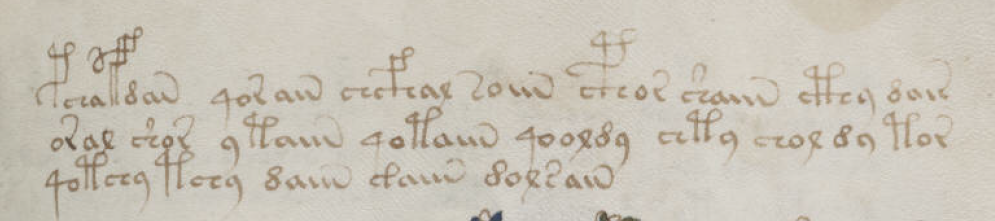
<f36r.1,@P0> <%>pchafdan.qorain.chcfhal.soiin.cphor.shaiin.cthy.dair
<f36r.2,+P0> oral.shor.ytaiin.qotaiin.qooldy.chty.chol.dy.tor
<f36r.3,+P0> qotchy.tchy.daiin.gaiin.dolsain<$>
ANALYSIS RESULT
Line f36r.1
[ORG] pchafdan.qorain.chcfhal.soiin.cphor.shaiin.cthy.dair
[ACA]
-
pchafdan = load/material: reactive saline flux (smelting mixture; “flux”)
-
qorain = QOR + -AIN (derived; no exact entry) → “coupling/interface in a fixed state”
-
chcfhal = procedural demonstrative connector (“on this / at this point”)
-
soiin = prepositional bridge (“over the / on the / in the”)
-
cphor = CPHO (vessel/container) + final variation (derived; no exact entry)
-
shaiin = completed state: sealed and fixed
-
cthy = transition bridge (“ties sub-step → next step”)
-
dair = fraction: clear liquor (clarified aqueous phase)
[FUN]
Introduce PCHAFDAN as the batch load (reactive saline flux), using it when the bath requires “cleaning” and improved process flow. Next, execute the directional coupling (QOR) and treat it as fixed (-AIN) before advancing. At this point, work on/within the containment vessel(s) (CPHO family) and bring the system to the sealed and fixed state (SHAIIN). Perform the transition bridge (CTHY) and integrate the aqueous fraction: collect/incorporate the clear liquor (DAIR) according to the protocol sequence.
Critical notes (rigor):
-
qorain does not exist as a “pure” entry in this version; the reading comes from QOR (to couple) + suffix -AIN (state). This is morphological reconstruction, not a “proven word.”
-
cphor is treated as a variant of the vessel CPHO (high confidence), with final -R as a graphic/agglutinated variation.
Line f36r.2
[ORG] oral.shor.ytaiin.qotaiin.qooldy.chty.chol.dy.tor
[ACA]
-
oral = deictic/positional marker (“now here/there”) (derived from ORALY/ORALD; no exact entry)
-
shor = open/release (break a seal / free a passage; venting)
-
ytaiin = Y + (TAIIN) (derived; no exact entry) → “and then: fixed/registered state” (stabilization marker)
-
qotaiin = QOT + -AIIN (derived; no exact entry) → “QOT core-action in a fixed/registered state”
-
qooldy = variant of QO- + OLDY (derived; approximates QOKOLDY) → reinjection/control over the oil slot (OLDY)
-
chty = maintain heating/cooking (continuous thermal regime)
-
chol = instrumental bridge (“with/by means of…”)
-
dy = prepositional bridge (“of/from”)
-
tor = named matter/reagent (“TOR” as a solid charge from inventory)
[FUN]
Mark the point (“now here/there”) and open/release to allow passage/venting (SHOR). Then bring the system into a registered stabilization (-AIIN), and treat the QOT core as fixed (QOT-AIIN) before continuing. Apply the QO- cycle-control operator over the oil (OLDY)—that is, perform reinjection/control of the oily medium as context requires. Maintain the thermal regime active (CHTY) and execute the step by means of the indicated instrument/medium (CHOL), connecting “of/from” (DY) to the reagent/charge TOR, which enters as preparation matter.
Critical notes (rigor):
-
ytaiin / qotaiin / qooldy / oral are readings by derivation, not exact entries. The strong cores here are: SHOR (opening control), CHTY (maintained heat), CHOL (instrumental), DY (genitive/linking), and TOR (named matter)—these have direct lexical support.
Line f36r.3
[ORG] qotchy.tchy.daiin.gaiin.dolsain
[ACA]
-
qotchy = QOT + CHY (derived; no exact entry) → “apply the QOT core to the selected target”
-
tchy = core of “interface/coupler” (derived; related to YTCHY as an interface bridge)
-
daiin = fixed/settled state (D- family)
-
gaiin = fixed/settled state (G- family)
-
dolsain = completed state “of the mark/sign” (del segno / della marca)
[FUN]
Apply the operative core QOT directed at a selected target (-CHY), using the interface coupler (TCHY) to “dock” the sub-step into the main flow. Then declare/register the system in a fixed state (DAIIN) and then in a subsequent/alternate fixed state (GAIIN), finishing in the mark/sign state (DOLSAIN) as a control close before proceeding.
Procedural synthesis of the excerpt
This block appears to execute a sequence of:
(1) introduction of a saline load/flux (PCHAFDAN) →
(2) coupling and fixing of an interface (QOR-AIN) →
(3) work “at this point/on the vessels” with sealing (SHAIIN) →
(4) integration of the clear liquor (DAIR) →
(5) controlled opening + stabilization (SHOR + -AIIN states) →
(6) control of an oily medium (OLDY) under operator QO- →
(7) thermal maintenance (CHTY) →
(8) instrumental and genitive linkage to the named matter (CHOL + DY + TOR) →
(9) closure via D-/G- states and a control mark (DAIIN → GAIIN → DOLSAIN).
The signature here is very “procedural”: many instrumental/prepositional connectors + fixed states + a selected target (-CHY).