
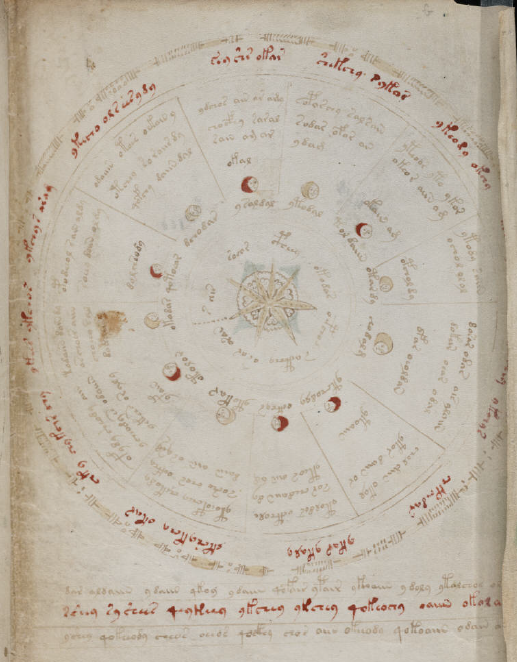
Tradução Procedural (f67r2.32 – f67r2.71)
L32–34 — Origem/destino, solvente e fixador resinoso
f67r2.32
[ORG] dorar.odar.ais.aloiin
[ACA]
-
dorar = ponte de direção/origem (“daqui a/para…”, encaixe sintático)
-
odar = avançar ao próximo passo (progressão do protocolo)
-
ais = ponte curta (liga termo→termo sem introduzir matéria)
-
aloiin = estado fixado/assentado (família ALO-)
[FUN]
Marque a transição “daqui para…” e avance o procedimento, conectando o alvo ao estado ALOIIN (assentado/fixado) como condição de estabilidade antes do próximo gesto.
f67r2.33
[ORG] dakan.osar.odal
[ACA]
-
dakan = [DERIVADO] provável composição DA + KAN (dose/medida padrão + ajuste de dosagem) (sem verbete direto)
-
osar = carga/matéria do passo (candidato nominal; “o reagente/payload”)
-
odal = solvente suave (água doce / veículo de lavagem e diluição)
[FUN]
Aplique uma dose ajustada do payload (OSAR) no solvente ODAL, mantendo a adição calibrada (sem “entornar tudo de uma vez”).
f67r2.34
[ORG] dfar.oeoldan
[ACA]
-
dfar = reagente/payload do passo (introdução controlada)
-
oeoldan = resina labdanum (fixador/aromático; incorpora melhor em meio oleoso)
[FUN]
Introduza DFAR conforme a dose do estágio e incorpore OEOLDAN como resina fixadora (estabiliza, “amarra” e preserva o composto — sobretudo quando há óleo na cadeia).
L35–37 — Estabilização por instrumental, assentamento e vertimento com repouso
f67r2.35
[ORG] chol.daiin.okol
[ACA]
-
chol = conector instrumental (“com/por meio de” ferramenta/meio)
-
daiin = estado fixado/assentado (família D-)
-
okol = estabilizar e deixar assentar (condição de repouso/clareamento)
[FUN]
Usando o meio/instrumento indicado (CHOL), coloque o lote em OKOL (repouso/assentamento) e trate-o como fixado (DAIIN) antes de prosseguir.
f67r2.36
[ORG] ytor.daiin.or
[ACA]
-
ytor = reagente nomeado “TOR” (aditivo/corpo do preparo)
-
daiin = estado fixado/assentado
-
or = ponte gramatical (artigo/ligação; não é matéria)
[FUN]
Some o reagente TOR ao conjunto e mantenha o sistema em regime assentado/fixado, usando OR apenas como ligação sintática do comando.
f67r2.37
[ORG] ytoaiin
[ACA]
-
ytoaiin = “então verta e deixe fixar/assentar” (transferência + repouso até separar claro/borra)
[FUN]
Faça o vertimento e deixe em repouso até o licor fixar e a borra assentar; só então avance.
L38–40 — Encadeamento “o qual…”, tópico “sobre…”, cocção já fixada e registro
f67r2.38
[ORG] otoldos.octhole
[ACA]
-
otoldos = [SEM_VERBETE] (pendente; aparenta composto OTOL/TOL, mas não está canônico nesta versão)
-
octhole = ponte referencial (“o qual / aquilo que”, liga instrução ao alvo correto)
[FUN]
Trate OCTHOLE como amarração (“aquilo que…”) apontando para o objeto correto. OTOLDOS permanece pendente: a operação/estado exato não é fechado sem verbete canônico.
f67r2.39
[ORG] sor.chedaiin.dy
[ACA]
-
sor = cabeçalho macro (“sobre / tópico do bloco”)
-
chedaiin = carga já cozida/termotratada, fixada (não reabrir cocção)
-
dy = genitivo “de/do/da” (origem/pertencimento; ligação)
[FUN]
Sobre a carga já coccionada e fixada, estabeleça a referência “de/do/da” para o que vem em seguida (sem reiniciar aquecimento).
f67r2.40
[ORG] yteos.oiin.om
[ACA]
-
yteos = registrar teor/leitura obtida (fechamento de medição)
-
oiin = ponte “em/no/para dentro” (inserção)
-
om = [SEM_VERBETE] (alvo/slot não identificado)
[FUN]
Registre a leitura final do teor (YTEOS) e aplique-a no ponto indicado; o destino OM ainda não está identificado no léxico atual, então aqui ele fica como “slot alvo pendente”.
L41–43 — Reagente alcalino (cal), inventário de itens, checagem e dupla fixação
f67r2.41
[ORG] ytoeopchey.chekody
[ACA]
-
ytoeopchey = [SEM_VERBETE] (forma sugere módulo composto envolvendo carga/operador; não canônico ainda)
-
chekody = cal / cal viva (álcali forte; base de lixívias)
[FUN]
Execute o módulo indicado (pendente) em associação com cal viva (CHEKODY), tratando a cal como base forte que ativa/ajusta extração e reatividade.
f67r2.42
[ORG] soshe.chos.ockhy
[ACA]
-
soshe = controle de selagem/solidificação (derivado de SHE-) (há ruído na etiqueta em inglês do verbete; valor funcional mantido)
-
chos = conjunto de itens/ingredientes (marcador de inventário)
-
ockhy = [VARIANTE] família OCKH- (checagem/controle), provável redução de OCKHEY/OCKHEDY (sem forma exata no dicionário)
[FUN]
Mantenha o controle operacional ativo (SOSHE), trate CHOS como “lista do que entra no passo” e aplique uma checagem de controle (OCKH-) antes de seguir.
f67r2.43
[ORG] daiin.aiin.os.yrl
[ACA]
-
daiin = fixado/assentado (família D-)
-
aiin = estado concluído/registrado (passivo: “já fixo”)
-
os = base adsorvente (cinza de osso / suporte técnico)
-
yrl = [SEM_VERBETE] (qualificador/slot pendente)
[FUN]
Leve o lote a fixação dupla (assentar + registrar como concluído) e então introduza/considere OS como base adsorvente do passo. O qualificador YRL permanece pendente e não é forçado.
L44–47 — Suporte (“folha”), selagem em curso, vertimento controlado e marca de posição
f67r2.44
[ORG] ofydy.sheody.aiin
[ACA]
-
ofydy = “a folha / o suporte” (derivado de OFY; uso como suporte operacional)
-
sheody = [DERIVADO] provável SHEOD + -Y (selagem/solidificação em curso)
-
aiin = estado concluído/registrado
[FUN]
Use a folha/suporte como parte do aparato e mantenha a selagem trabalhando (em curso) até que o estado esteja registrado como concluído.
f67r2.45
[ORG] ycheody.es.odaiiin
[ACA]
-
ycheody = [DERIVADO] provável YCHEOD + -Y (verter/trasfegar em curso, evitando borra)
-
es = conector (“e/é/está”; coordenação)
-
odaiiin = [VARIANTE] de ODAIIN (modo assentado/registrado; estabilizar e manter)
[FUN]
Faça o vertimento controlado (sem turvar o fundo) e mantenha em modo assentado/registrado (ODAIIN). O “III” é tratado aqui como variante gráfica do estado canônico.
f67r2.46
[ORG] yekees.oraly
[ACA]
-
yekees = [SEM_VERBETE] (provável parente da família deíctica EKEY/EKEEY “aqui”, mas não canônico)
-
oraly = marcador posicional (“agora ali / aí”, âncora local)
[FUN]
Aplique a marca de posição (ORALY) para ancorar o gesto “no ponto ali/aí”. YEKEES fica como pendência (deíxis provável, mas não fechada).
f67r2.47
[ORG] yfain
[ACA]
-
yfain = estado de encerramento (candidato nominal; “processo encerrado neste estado”)
[FUN]
Considere o passo encerrado neste estado e mantenha o conjunto em repouso breve antes da próxima sequência.
L48–51 — Entrega/fixação, vaso alvo selado, fecho contínuo com sal e termo incerto
f67r2.48
[ORG] todaiin.dain.dy
[ACA]
-
todaiin = [DERIVADO] provável TOD + -AIIN (“resultado entregue em estado fixado”) (forma não canônica; núcleo TOD é canônico)
-
dain = genitivo curto (“do/da”, procedência)
-
dy = genitivo “de/do/da” (ponte)
[FUN]
Entregue/feche o resultado já em estado fixado e explicite a procedência (“do/da…”) pela dupla ponte genitiva (DAIN/DY), mantendo rastreabilidade de origem dentro do protocolo.
f67r2.49
[ORG] orchoer.aiin
[ACA]
-
orchoer = recipiente alvo operacional (jarro/vaso de destino)
-
aiin = estado concluído/registrado
[FUN]
Garanta que o vaso alvo esteja firme, selado e pronto para receber/guardar o conteúdo, com o estado marcado como concluído.
f67r2.50
[ORG] choeey.sar
[ACA]
-
choeey = fecho/selagem em ação contínua (gerúndio de fechamento)
-
sar = sal (fração salina/alcalina; reagente)
[FUN]
Mantenha o fecho ativo enquanto aplica sal como reagente (ajuste, reação, precipitação ou ativação conforme o contexto do lote).
f67r2.51
[ORG] dacsa?ry?
[ACA]
-
dacsa?ry? = [?] termo graficamente incerto (caso especial)
[FUN]
Token não traduzido: permanece como marcador de incerteza. Qualquer tentativa de leitura aqui seria “forçar encaixe”.
L52–63 — Protocolo de suporte (marginal): operadores e sub-rotinas encadeadas
Aqui o manuscrito entra em modo “lista de comandos”: itens curtos que funcionam como sub-rotinas/operadores.
-
qotoear = operador associado ao insumo EAR (matéria vegetal base)
-
dchodar = conduzir ao conduto e controlar vazão (fluxo estável)
-
ysaldal = sal/fluxo salino de solda (aplicação em junta/ligação)
-
ytodal = manter o passo pelo tempo-alvo marcado (duração prescrita)
-
tol.daiin = verter/decantar e então deixar fixar/assentar
-
otardy = [DERIVADO] provável OTARD + -Y (calibrar/tarar medida em curso)
-
chodalg = guiar o fluxo pelo canal/funil/bico com estabilidade
-
ytchodyy = [VARIANTE] de YTCHODY (prova por toque/amostra para checar ponto/qualidade)
-
octhys = estado final “cozido / levado à cocção”
-
ytokar = carregar/impregnar o “KAR” (fazer beber o licor até saturar)
-
otolor = fração oleosa/espírito (conserva, sela, suaviza)
-
okadar = executar gesto técnico no slot/compartimento ativo do aparato
[FUN]
Execute a rotina de suporte: aplique a matéria EAR, conduza o fluxo no conduto com controle, use o sal/fluxo quando houver junta/ligação, respeite o tempo-alvo, decante e assente, calibre medidas quando necessário, faça prova por amostra, finalize em estado cozido quando indicado, carregue o portador (KAR), estabilize com fração oleosa (TOLOR) e execute o gesto técnico no slot do aparato.
L64–71 — Encerramento: meio de aeração, referência “sobre o qual”, vaso em ação contínua, filtrado, não-solidificado, carga e repouso
f67r2.64–71
[ORG] s.air | soeor | cpheey | okodas | oepchol | sacthhy | osar | oran
[ACA]
-
s = [SEM_VERBETE] (provável abreviação de cabeçalho tipo SOR-, mas não canônico)
-
air = ar / meio / aeração (instrumento/condição)
-
soeor = ponte “sobre o qual / a respeito do qual”
-
cpheey = vaso de contenção em ação contínua (modo operacional)
-
okodas = selo/fecho como referência de slot/compartimento do aparato
-
oepchol = fração líquida / filtrado (o licor resultante)
-
sacthhy = “não solidificado” (estado ainda maleável)
-
osar = carga/matéria do passo
-
oran = regime de repouso/cura (janela de espera para assentar/estabilizar)
[FUN]
Finalize usando o meio de aeração (AIR) como condição do encerramento e amarre o bloco por referência (“sobre o qual…”). Mantenha o vaso operando em modo contínuo, trate o slot de fecho como referência interna (OKODAS), separe e trabalhe com o filtrado (OEPCHOL), verifique a condição não solidificada e então deixe a carga em ORAN (repouso/cura) até estabilizar.
Síntese procedural do trecho (leitura reconstruída)
Este recorte opera como uma sequência de conexão de origem/destino → adição em solvente → incorporação de resina → assentamento/OKOL → vertimento com repouso → bloco “sobre a carga cozida” → registro de teor → alcalinização (cal) + checagem → dupla fixação com adsorvente (OS) → suporte/folha + selagem em curso → entrega fixada e vaso alvo selado → fecho contínuo com sal → lista marginal de sub-rotinas → fechamento com filtrado, estado “não solidificado” e repouso ORAN.
<f67r2.32,@Pb> <%>dorar.odar.ais.aloiin
<f67r2.33,+Pb> dakan.osar.odal<$>
<f67r2.34,+L0> dfar.oeoldan
<f67r2.35,@Pb> <%>chol.daiin.okol
<f67r2.36,+Pb> ytor.daiin.or<$>
<f67r2.37,+L0> ytoaiin
<f67r2.38,@Pb> <%>otoldos.octhole
<f67r2.39,+Pb> sor.chedaiin.dy
<f67r2.40,+Pb> yteos.oiin.om<$>
<f67r2.41,@Pb> <%>ytoeopchey.chekody
<f67r2.42,+Pb> soshe.chos.ockhy
<f67r2.43,+Pb> daiin.aiin.os.yrl<$>
<f67r2.44,@Pb> <%>ofydy.sheody.aiin
<f67r2.45,+Pb> ycheody.es.odaiiin
<f67r2.46,+Pb> yekees.oraly<$>
<f67r2.47,+L0> yfain
<f67r2.48,@Pb> <%>todaiin.dain.dy
<f67r2.49,+Pb> orchoer.aiin
<f67r2.50,+Pb> choeey.sar
<f67r2.51,+Pb> dacsa?ry?<$>
<f67r2.52,@Ls> qotoear
<f67r2.53,&Ls> dchodar
<f67r2.54,&Ls> ysaldal
<f67r2.55,&Ls> ytodal
<f67r2.56,&Ls> tol.daiin
<f67r2.57,&Ls> otardy
<f67r2.58,&Ls> chodalg
<f67r2.59,&Ls> ytchodyy
<f67r2.60,&Ls> octhys
<f67r2.61,&Ls> ytokar
<f67r2.62,&Ls> otolor
<f67r2.63,&Ls> okadar
<f67r2.64,@L0> s.air
<f67r2.65,&L0> soeor
<f67r2.66,&L0> cpheey
<f67r2.67,&L0> okodas
<f67r2.68,&L0> oepchol
<f67r2.69,&L0> sacthhy
<f67r2.70,&L0> osar
<f67r2.71,&L0> oran
Procedural Translation (f67r2.32 – f67r2.71)
L32–34 — Origin/destination, solvent, and resin fixative
f67r2.32
[ORG] dorar.odar.ais.aloiin
[ACA]
-
dorar = direction/origin bridge (“from here to / toward…”, syntactic slotting)
-
odar = advance to the next step (protocol progression)
-
ais = short bridge (links term→term without introducing material)
-
aloiin = fixed/settled state (family ALO-)
[FUN]
Mark the transition “from here to…” and advance the procedure, linking the target to the ALOIIN (settled/fixed) state as a stability condition before the next gesture.
f67r2.33
[ORG] dakan.osar.odal
[ACA]
-
dakan = [DERIVED] likely compound DA + KAN (standard dose/measure + dosage adjustment) (no direct entry)
-
osar = step payload/material (nominal candidate; “the reagent/payload”)
-
odal = mild solvent (fresh water / wash-and-dilution vehicle)
[FUN]
Apply an adjusted dose of the payload (OSAR) into the ODAL solvent, keeping the addition calibrated (don’t “dump it all in at once”).
f67r2.34
[ORG] dfar.oeoldan
[ACA]
-
dfar = step reagent/payload (controlled introduction)
-
oeoldan = labdanum resin (fixative/aromatic; incorporates better in an oily medium)
[FUN]
Introduce DFAR according to the stage dose and incorporate OEOLDAN as a resin fixative (stabilizes, “binds,” and preserves the compound—especially when oil is present in the chain).
L35–37 — Stabilization via instrumentation, settling, and pouring with rest
f67r2.35
[ORG] chol.daiin.okol
[ACA]
-
chol = instrumental connector (“with / by means of” tool/medium)
-
daiin = fixed/settled state (family D-)
-
okol = stabilize and let settle (rest/clarification condition)
[FUN]
Using the indicated medium/instrument (CHOL), place the batch into OKOL (rest/settling) and treat it as fixed (DAIIN) before proceeding.
f67r2.36
[ORG] ytor.daiin.or
[ACA]
-
ytor = named reagent “TOR” (additive/body of the preparation)
-
daiin = fixed/settled state
-
or = grammatical bridge (article/link; not material)
[FUN]
Add the TOR reagent to the batch and keep the system in a settled/fixed regime, using OR only as the command’s syntactic linkage.
f67r2.37
[ORG] ytoaiin
[ACA]
-
ytoaiin = “then pour and let it fix/settle” (transfer + rest until clear/sediment separates)
[FUN]
Pour/decant and leave it at rest until the liquor fixes and the sediment settles; only then proceed.
L38–40 — Chaining “which…”, topic “on/about…”, already-fixed cooking, and logging
f67r2.38
[ORG] otoldos.octhole
[ACA]
-
otoldos = [NO_ENTRY] (pending; appears to be an OTOL/TOL compound, but not canonical in this version)
-
octhole = referential bridge (“which / that which”, links the instruction to the correct target)
[FUN]
Treat OCTHOLE as a binding reference (“that which…”) pointing to the correct object. OTOLDOS remains pending: the exact operation/state cannot be closed without a canonical entry.
f67r2.39
[ORG] sor.chedaiin.dy
[ACA]
-
sor = macro header (“on / topic of the block”)
-
chedaiin = payload already cooked/heat-treated, fixed (do not reopen cooking)
-
dy = genitive “of/from” (origin/possession; linkage)
[FUN]
On the payload that is already cooked and fixed, set the “of/from” reference for what follows (without restarting heating).
f67r2.40
[ORG] yteos.oiin.om
[ACA]
-
yteos = record the obtained strength/reading (measurement closeout)
-
oiin = bridge “in/into/on” (insertion)
-
om = [NO_ENTRY] (target/slot not identified)
[FUN]
Record the final strength reading (YTEOS) and apply it to the indicated point; the destination OM is not identified in the current lexicon, so it remains a “pending target slot” here.
L41–43 — Alkaline reagent (lime), item inventory, check, and double fixation
f67r2.41
[ORG] ytoeopchey.chekody
[ACA]
-
ytoeopchey = [NO_ENTRY] (form suggests a compound module involving payload/operator; not canonical yet)
-
chekody = lime / quicklime (strong alkali; base for lyes)
[FUN]
Execute the indicated module (pending) in association with quicklime (CHEKODY), treating lime as a strong base that activates/adjusts extraction and reactivity.
f67r2.42
[ORG] soshe.chos.ockhy
[ACA]
-
soshe = sealing/solidification control (derived from SHE-) (there is noise in the entry’s English label; functional value retained)
-
chos = item/ingredient set (inventory marker)
-
ockhy = [VARIANT] OCKH- family (check/control), likely a reduced form of OCKHEY/OCKHEDY (no exact form in the dictionary)
[FUN]
Keep operational control active (SOSHE), treat CHOS as “the list of what goes into the step,” and run a control check (OCKH-) before continuing.
f67r2.43
[ORG] daiin.aiin.os.yrl
[ACA]
-
daiin = fixed/settled (D- family)
-
aiin = completed/recorded state (passive: “already fixed”)
-
os = adsorbent base (bone ash / technical substrate)
-
yrl = [NO_ENTRY] (qualifier/pending slot)
[FUN]
Bring the batch to double fixation (settle + record as completed) and then introduce/consider OS as the step’s adsorbent base. The qualifier YRL remains pending and is not forced.
L44–47 — Support (“sheet”), sealing in progress, controlled pouring, and a position marker
f67r2.44
[ORG] ofydy.sheody.aiin
[ACA]
-
ofydy = “the sheet / support” (derived from OFY; used as an operational support)
-
sheody = [DERIVED] likely SHEOD + -Y (sealing/solidification in progress)
-
aiin = completed/recorded state
[FUN]
Use the sheet/support as part of the apparatus and keep the sealing working (in progress) until the state is recorded as completed.
f67r2.45
[ORG] ycheody.es.odaiiin
[ACA]
-
ycheody = [DERIVED] likely YCHEOD + -Y (controlled pouring/transfer in progress, avoiding sediment)
-
es = connector (“and / is / is-in”; coordination)
-
odaiiin = [VARIANT] of ODAIIN (settled/recorded mode; stabilize and maintain)
[FUN]
Perform a controlled pour/transfer (do not cloud the bottom) and keep it in settled/recorded mode (ODAIIN). The “III” is treated here as a graphic variant of the canonical state.
f67r2.46
[ORG] yekees.oraly
[ACA]
-
yekees = [NO_ENTRY] (likely related to the deictic family EKEY/EKEEY “here”, but not canonical)
-
oraly = positional marker (“now there / right there”, local anchor)
[FUN]
Apply the position marker (ORALY) to anchor the gesture “at that point there.” YEKEES stays pending (probable deixis, but not closed).
f67r2.47
[ORG] yfain
[ACA]
-
yfain = closing state (nominal candidate; “process closed in this state”)
[FUN]
Treat the step as closed in this state and keep the batch at brief rest before the next sequence.
L48–51 — Delivery/fixation, sealed target vessel, continuous closure with salt, and an uncertain term
f67r2.48
[ORG] todaiin.dain.dy
[ACA]
-
todaiin = [DERIVED] likely TOD + -AIIN (“output delivered in a fixed state”) (form not canonical; core TOD is canonical)
-
dain = short genitive (“of/from”, provenance)
-
dy = genitive “of/from” (bridge)
[FUN]
Deliver/close the result already in a fixed state and make provenance explicit (“of/from…”) via the double genitive bridge (DAIN/DY), preserving origin traceability inside the protocol.
f67r2.49
[ORG] orchoer.aiin
[ACA]
-
orchoer = operational target container (destination jar/vessel)
-
aiin = completed/recorded state
[FUN]
Ensure the target vessel is firm, sealed, and ready to receive/store the contents, with the state marked as completed.
f67r2.50
[ORG] choeey.sar
[ACA]
-
choeey = closure/sealing in continuous action (gerund/ongoing closure)
-
sar = salt (saline/alkaline fraction; reagent)
[FUN]
Keep the closure active while applying salt as a reagent (adjustment, reaction, precipitation, or activation depending on batch context).
f67r2.51
[ORG] dacsa?ry?
[ACA]
-
dacsa?ry? = [?] graphically uncertain term (special case)
[FUN]
Token not translated: it remains as an uncertainty marker. Any reading attempt here would be “forcing a fit.”
L52–63 — Support protocol (marginal): chained operators and subroutines
Here the manuscript enters “command-list” mode: short items that function as subroutines/operators.
-
qotoear = operator associated with the input EAR (base plant matter)
-
dchodar = drive into the conduit and control flow rate (stable flow)
-
ysaldal = salt/saline solder-flow (application at a joint/bond)
-
ytodal = hold the step for the marked target time (prescribed duration)
-
tol.daiin = pour/decant and then let it fix/settle
-
otardy = [DERIVED] likely OTARD + -Y (calibrate/tare a measurement in progress)
-
chodalg = guide the flow through the channel/funnel/spout with stability
-
ytchodyy = [VARIANT] of YTCHODY (touch/sample test to check point/quality)
-
octhys = final state “cooked / brought to cooking”
-
ytokar = load/impregnate the “KAR” (make it drink the liquor until saturated)
-
otolor = oily fraction/spirit (preserves, seals, softens)
-
okadar = execute a technical gesture in the apparatus’s active slot/compartment
[FUN]
Execute the support routine: apply the EAR material, drive and control the flow in the conduit, use salt/flow when there is a joint/bond, respect the target time, decant and settle, calibrate measurements when needed, perform a sample test, finish in the cooked state when indicated, load the carrier (KAR), stabilize with the oily fraction (TOLOR), and execute the technical gesture in the apparatus slot.
L64–71 — Closeout: aeration medium, “on which” reference, vessel in continuous action, filtrate, non-solidified state, payload, and rest
f67r2.64–71
[ORG] s.air | soeor | cpheey | okodas | oepchol | sacthhy | osar | oran
[ACA]
-
s = [NO_ENTRY] (likely an abbreviation of an SOR- type header, but not canonical)
-
air = air / medium / aeration (instrument/condition)
-
soeor = bridge “on which / with respect to which”
-
cpheey = containment vessel in continuous action (operational mode)
-
okodas = seal/closure as a reference for an apparatus slot/compartment
-
oepchol = liquid fraction / filtrate (the resulting liquor)
-
sacthhy = “not solidified” (state still malleable)
-
osar = step payload/material
-
oran = rest/cure regime (wait window for settling/stabilizing)
[FUN]
Close out using the aeration medium (AIR) as the condition for completion and bind the block by reference (“on which…”). Keep the vessel operating in continuous mode, treat the closure slot as an internal reference (OKODAS), separate and work with the filtrate (OEPCHOL), verify the non-solidified condition, and then leave the payload in ORAN (rest/cure) until stabilized.
Procedural synthesis of the excerpt (reconstructed reading)
This excerpt operates as a sequence of origin/destination linking → solvent addition → resin incorporation → settling/OKOL → pouring with rest → “on the cooked payload” block → strength logging → alkalinization (lime) + checking → double fixation with adsorbent (OS) → support/sheet + sealing in progress → fixed delivery and sealed target vessel → continuous closure with salt → marginal subroutine list → closeout with filtrate, “non-solidified” state, and ORAN rest.