
RESULTADO DE ANÁLISE
Linha f1r.1
[ORG] fachys.ykal.ar.ataiin.shol.shory.cthres.y.kor.sholdy
[ACA]
-
fachys = selar completamente (fecho final)
-
ykal = álcali primário (potassa de cinzas vegetais)
-
ar = ponte direcional (a/para/em)
-
ataiin = estado selado/fixado (-AIIN)
-
shol = meio oleoso / banho de óleo
-
shory = liberar passagem / abrir-soltar (operação em curso) (ver nota de ambiguidade abaixo)
-
cthres = controle de fluxo / marcador 3º (ordinal)
-
y = [CON:Y] conector curto (“e/então”) (derivado; sem verbete dedicado)
-
kor = corpo do material (massa/substância)
-
sholdy = banho de óleo como ponte instrumental (“por meio de / através do meio oleoso”)
[FUN]
Vede o vaso por completo e trate o sistema como selado/fixado. Prepare a potassa (álcali de cinzas vegetais) e direcione sua aplicação/transferência para o estágio do banho de óleo. Na terceira marca do fluxo, libere a passagem e faça a massa do material operar por meio do meio oleoso.
Notas críticas (rigor):
-
SHORY: o verbete traz um sentido operativo claro (“abrir/soltar/liberar”), mas há ruído interno em uma etiqueta em inglês no dicionário. Neste trecho eu mantenho SHORY como liberação de passagem, porém registro a ambiguidade para auditoria posterior.
Linha f1r.2
[ORG] sory.ckhar.or.y.kair.chtaiin.shar.are.cthar.cthar.dan
[ACA]
-
sory = marcador de retorno/checkpoint (voltar ao ponto de controle)
-
ckhar = controle/inspeção (ato de checagem)
-
or = ponte gramatical (artigo elidido + ligação)
-
y = [CON:Y] “e/então” (derivado)
-
kair = conector referencial (“ao qual / em relação a”)
-
chtaiin = aquecer/cozer em estado fixado (-AIIN)
-
shar = apertar/vedar (comando)
-
are = marcador de estágio (“aqui/agora/neste ponto”)
-
cthar cthar = componente/substância (duplicação = duas passagens/duas porções)
-
dan = fechamento por microdose (“encerre a dose”)
[FUN]
Retorne ao ponto de controle e inspecione o estado do sistema. Confirme o regime térmico já fixado e, neste estágio, aperte/vede a montagem. Aplique o componente em duas passagens (ou duas porções) e encerre o passo com a microdose final de fechamento.
Linha f1r.3
[ORG] syaiir.sheky.or.ykaiin.shod.cthoary.cthes.daraiin.sa
[ACA]
-
syaiir = vapor/fluxo secundário como meio/veículo (CONF baixa-média)
-
sheky = selagem/solidificação (controle de fechamento em curso) (há ruído interno no dicionário; ver nota)
-
or = ponte gramatical
-
ykaiin = “então, deixe estabilizar” (registrar estado alcançado)
-
shod = fecho/selagem hermética
-
cthoary = macroseção/segmento qualificado (objeto procedural)
-
cthes = operador de etapa (ação procedural)
-
daraiin = [UNK] (sem verbete; termina como -AIIN, sugerindo “estado fixado”, mas ainda não validado)
-
sa = reagente salino (sal)
[FUN]
Use o vapor/fluxo secundário como veículo do processo e mantenha o controle de fechamento ativo. Em seguida, deixe estabilizar e então execute o fecho hermético do segmento principal. Aplique o operador de etapa previsto e introduza o sal para modular a reação/condição. O termo daraiin aparece como estado possível (por forma), mas permanece não definido nesta versão do léxico.
Nota crítica (rigor):
-
SHEKY tem um rótulo em inglês que não combina perfeitamente com a descrição principal do verbete. Aqui eu sigo a descrição funcional (“selagem/solidificação em curso”) e deixo o conflito registrado.
Linha f1r.4
[ORG] ooiin.oteey.oteos.roloty.cth?ar.daiin.otaiin.or.okan
[ACA]
-
ooiin = inspeção/checagem visual
-
oteey = executar obtenção/extração (passo imperativo)
-
oteos = porções selecionadas (payload do passo)
-
roloty = [UNK] (sem verbete)
-
cth?ar = [?] termo com incerteza gráfica (caso especial; ver abaixo)
-
daiin = estado fixado/assentado (família D-) (-AIIN)
-
otaiin = [UNK] (forma sugere estado fixado por -AIIN, mas sem verbete dedicado)
-
or = ponte gramatical
-
okan = conector de ancoragem (“ligar/ancorar o passo ao ponto do aparato”)
[FUN]
Faça uma checagem visual do estado do sistema. Execute a etapa de obtenção/extração e separe as porções selecionadas. Em seguida, ocorrem dois pontos ainda não resolvidos (roloty e cth?ar). Depois, mantenha o procedimento em estado fixado/assentado, aplique o estado indicado por otaiin (a validar) e ancore a sequência ao ponto do aparato indicado.
Caso especial:
-
cth?ar é marcado com “?” e deve ser tratado como grafia incerta/variante. Por enquanto ele fica isolado como pendência, sem forçar equivalência.
Linha f1r.5
[ORG] dair.y.chear.cthaiin.cphar.cfhaiin
[ACA]
-
dair = licor claro (fração aquosa clarificada)
-
y = [CON:Y] “e/então” (derivado)
-
chear = aeração/ventilação (condição de processo: expor ao ar)
-
cthaiin = subetapa/entrada em estase (marcador fixado) (-AIIN)
-
cphar = recipiente/vaso (copo/jarro da família CPH)
-
cfhaiin = marcador de registro/suporte fixado (-AIIN)
[FUN]
Recolha a fração clara (licor) e conduza uma etapa de aeração/ventilação. Marque a subetapa como fixada e transfira para o recipiente de contenção. Em seguida, registre o ponto de suporte/controle e mantenha o estado em estase antes de prosseguir.
Linha f1r.6
[ORG] ydaraishy
[ACA]
-
ydaraishy = deixar liberar / auto-entregar (modo impessoal: “não force”)
[FUN]
Deixe o preparado liberar espontaneamente, sem intervenção agressiva. Observe o escoamento/saída até estabilizar.
Síntese procedural do trecho (leitura reconstruída)
Em termos de fluxo operacional, este bloco descreve uma cadeia coerente de:
selagem → aplicação de reagente alcalino → operação em banho oleoso → controle térmico fixado → estabilização → extração de porções → coleta do licor claro → estase/repouso → liberação espontânea.
Isso não “prova” o processo químico específico (o que seria uma camada posterior), mas mostra uma assinatura forte de texto de execução: muitos marcadores de estado fixado (-AIIN), etapas de controle, inspeção, estabilização, extração e repouso.
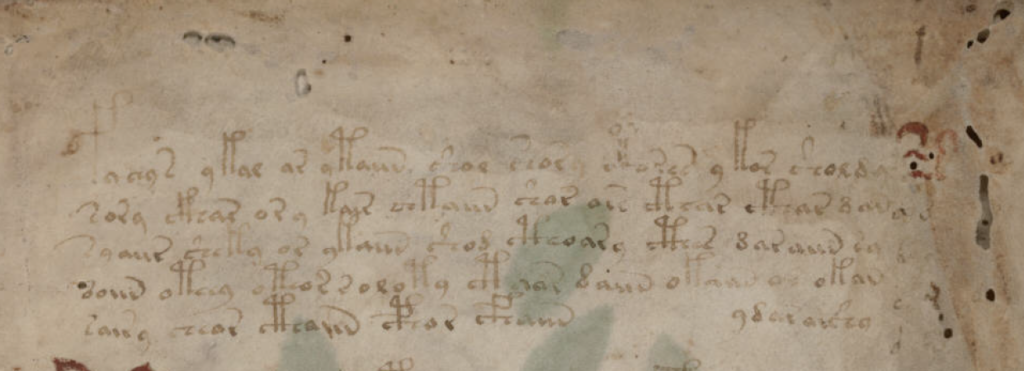
<f1r.1,@P0> <%>fachys.ykal.ar.ataiin.shol.shory.cthres.y.kor.sholdy
<f1r.2,+P0> sory.ckhar.or.y.kair.chtaiin.shar.are.cthar.cthar.dan
<f1r.3,+P0> syaiir.sheky.or.ykaiin.shod.cthoary.cthes.daraiin.sa
<f1r.4,+P0> ooiin.oteey.oteos.roloty.cth?ar.daiin.otaiin.or.okan
<f1r.5,+P0> dair.y.chear.cthaiin.cphar.cfhaiin
<f1r.6,=Pt> ydaraishy<$>
ANALYSIS RESULT
Line f1r.1
[ORG] fachys.ykal.ar.ataiin.shol.shory.cthres.y.kor.sholdy
[ACA]
-
fachys = seal completely (final closure)
-
ykal = primary alkali (potash from plant ash)
-
ar = directional bridge (to/from/in)
-
ataiin = sealed/fixed state (-AIIN)
-
shol = oily medium / oil bath
-
shory = release passage / open–let through (operation in progress) (see ambiguity note below)
-
cthres = flow control / 3rd marker (ordinal)
-
y = [CON:Y] short connector (“and/then”) (derived; no dedicated entry)
-
kor = body of the material (mass/substance)
-
sholdy = oil bath as an instrumental bridge (“by means of / through the oily medium”)
[FUN]
Seal the vessel completely and treat the system as sealed/fixed. Prepare the potash (alkali from plant ash) and direct its application/transfer into the oil-bath stage. At the third flow marker, release the passage and have the material mass operate through the oily medium.
Critical notes (rigor):
-
SHORY: the entry has a clear operative sense (“open/release/let through”), but there is internal noise from an English label in the dictionary. In this passage I keep SHORY as passage release, while logging the ambiguity for later audit.
Line f1r.2
[ORG] sory.ckhar.or.y.kair.chtaiin.shar.are.cthar.cthar.dan
[ACA]
-
sory = return/checkpoint marker (go back to the control point)
-
ckhar = control/inspection (act of checking)
-
or = grammatical bridge (elided article + link)
-
y = [CON:Y] “and/then” (derived)
-
kair = referential connector (“to which / with respect to”)
-
chtaiin = heat/cook in a fixed state (-AIIN)
-
shar = tighten/seal (command)
-
are = stage marker (“here/now/at this point”)
-
cthar cthar = component/substance (duplication = two passes/two portions)
-
dan = microdose closure (“close the dose”)
[FUN]
Return to the control point and inspect the system state. Confirm the already-fixed thermal regime and, at this stage, tighten/seal the assembly. Apply the component in two passes (or two portions) and close the step with the final microdose seal.
Line f1r.3
[ORG] syaiir.sheky.or.ykaiin.shod.cthoary.cthes.daraiin.sa
[ACA]
-
syaiir = secondary vapor/flow as a medium/vehicle (low–medium CONF)
-
sheky = sealing/solidifying (closure control in progress) (internal noise in the dictionary; see note)
-
or = grammatical bridge
-
ykaiin = “then, let it stabilize” (record the reached state)
-
shod = hermetic closure/seal
-
cthoary = macro-section/qualified segment (procedural object)
-
cthes = step operator (procedural action)
-
daraiin = [UNK] (no entry; ends in -AIIN, suggesting “fixed state,” but not validated yet)
-
sa = saline reagent (salt)
[FUN]
Use the secondary vapor/flow as the process vehicle and keep closure control active. Then allow it to stabilize, and execute the hermetic seal of the main segment. Apply the expected step operator and introduce salt to modulate the reaction/condition. The term daraiin appears as a possible state (by form), but remains undefined in this lexicon version.
Critical note (rigor):
-
SHEKY has an English label that does not perfectly match the entry’s main description. Here I follow the functional description (“sealing/solidifying in progress”) and log the conflict.
Line f1r.4
[ORG] ooiin.oteey.oteos.roloty.cth?ar.daiin.otaiin.or.okan
[ACA]
-
ooiin = visual inspection/check
-
oteey = execute acquisition/extraction (imperative step)
-
oteos = selected portions (step payload)
-
roloty = [UNK] (no entry)
-
cth?ar = [?] graphically uncertain term (special case; see below)
-
daiin = fixed/settled state (D-family) (-AIIN)
-
otaiin = [UNK] (form suggests a fixed state via -AIIN, but no dedicated entry)
-
or = grammatical bridge
-
okan = anchoring connector (“link/anchor the step to the apparatus point”)
[FUN]
Perform a visual check of the system state. Execute the acquisition/extraction step and separate the selected portions. Two points remain unresolved (roloty and cth?ar). Then keep the procedure in a fixed/settled state, apply the state indicated by otaiin (to be validated), and anchor the sequence to the indicated apparatus point.
Special case:
-
cth?ar is marked with “?” and must be treated as uncertain spelling/variant. For now it stays isolated as a pending item, without forcing equivalence.
Line f1r.5
[ORG] dair.y.chear.cthaiin.cphar.cfhaiin
[ACA]
-
dair = clear liquor (clarified aqueous fraction)
-
y = [CON:Y] “and/then” (derived)
-
chear = aeration/ventilation (process condition: expose to air)
-
cthaiin = sub-step / entry into stasis (fixed marker) (-AIIN)
-
cphar = container/vessel (cup/jar of the CPH family)
-
cfhaiin = fixed support/record marker (-AIIN)
[FUN]
Collect the clear fraction (liquor) and run an aeration/ventilation step. Mark the sub-step as fixed and transfer it to the holding container. Then record the support/control point and keep the state in stasis before proceeding.
Line f1r.6
[ORG] ydaraishy
[ACA]
-
ydaraishy = allow release / self-deliver (impersonal mode: “do not force”)
[FUN]
Let the preparation release on its own, without aggressive intervention. Observe the outflow/output until it stabilizes.
Procedural synthesis of the passage (reconstructed reading)
In operational flow terms, this block describes a coherent chain of:
sealing → applying an alkaline reagent → operating in an oil bath → fixed thermal control → stabilization → extraction of portions → collection of clear liquor → stasis/rest → spontaneous release.
This does not “prove” the specific chemical process (that would be a later layer), but it shows a strong execution-text signature: many fixed-state (-AIIN) markers, plus control, inspection, stabilization, extraction, and rest steps.