
Tradução procedural — f103r.8 a f103r.15
L8 — f103r.8
[ORG] daroal.okey.chedy.okey.rain.okechy.qoisol.qotar.adchey.ofcho.lteody.oral.kechdy.lo
[ACA] dar ao/à (ponte) · [OKEY] (deíxis/slot) · cocção controlada · [OKEY] (deíxis/slot) · [RAIN] (estado/parte) · com que/ao qual (cui) · escopo de isolamento/separação · [QOTAR] (ajuste/tara/medida) · a que/para que · flor/espuma superficial (sobrenadante) · correção de teor/concentração · [ORAL] (marcador posicional) · daqui/deste ponto · [LO] (artigo)
[FUN] Aplique o encadeamento “dar ao/à” para entregar a operação ao ponto/slot indicado; execute cocção controlada e mantenha o procedimento ancorado no mesmo ponto. Ao atingir o estado/parte marcado por RAIN, conecte “com que/ao qual” para amarrar o alvo e então ative o escopo de isolamento/separação. Faça o ajuste de medida/tara para cumprir a finalidade (“a que/para que”), remova a “flor”/espuma superficial como indicador de clarificação e realize a correção pontual de teor. Em seguida, marque o posicionamento (“agora ali/aí”), avance “daqui/deste ponto” e feche com o artigo final (conclusão sintática).
Notas de normalização (L8):
-
chedy→ casa muito bem com KCHEDY (cocção controlada). -
okechynão existe como lema isolado; o encaixe funcional mais estável é KECHY (“com que/ao qual; cui”). -
qotar,okey,rain,oral,lonão aparecem como lemas exatos no V27.47 A (ficam como validação pendente/por variante).
L9 — f103r.9
[ORG] oteeos.ar.cheal.okeey.shey.lkaiin.shey.lkeor.otain.shedy.otey.l.ledy.okeedaram
[ACA] porções do material (OTEOS) · para/em direção a · ao qual/à qual · [OKEEY] (deíxis/âncora) · selagem/fechamento em curso · [LKAIIN] (estado concluído/relacional) · selagem/fechamento em curso · licor/solução (payload) · [OTAIN] (estado/recipiente vedado) · selagem/fechamento · obter/retirar · [L] (artigo elidido “l’”) · “das” (genitivo fem. pl.) · “daqui em diante (modo)”
[FUN] Separe as porções do material e direcione-as ao alvo referenciado (“ao qual”). Fixe o procedimento no ponto indicado (okeey) e mantenha a selagem ativa até o conjunto entrar no estado concluído (lkaiin). Em seguida, sob selagem, introduza/associe o licor/solução (lkeor) e estabilize o estado/recipiente indicado por otain. Reforce a vedação (shedy), retire/obtenha a fração designada e feche a origem por genitivo (“das…”). A partir daqui, opere no modo procedural “okeedaram” (marcador interno de continuidade do protocolo, não leitura geográfica).
Notas de normalização (L9):
-
oteeos→ variante gráfica que se encaixa em OTEOS/OETEOS (porções OTEO). -
otey→ encaixa por função em OTEEY (“obter/retirar”). -
lkaiinnão existe como lema exato; candidatos próximos e coerentes por função: ALKAIIN / OLKAIIN / LOLKAIIN (família “-AIIN” concluído + conectivo). -
okeey/otain/lsão âncoras formais fortes, mas precisam de validação como lema exato (ou regra de elisão).
L10 — f103r.10
[ORG] daiin.ol.oain.okeol.chal.okam.chety.shedy.otaiin.shedy.teolshy.oteedy.sarain
[ACA] estado fixado/assentado (família D-) · ao/para o · pivô/microbloco (marcador “an”) · slot/âncora de compartimento (aparato) · cal (base alcalina) · aparato em slot (encaixe instrumental) · “estes itens” (plural deíctico) · selagem/fechamento · [OTAIIN] (estado fixado) · selagem/fechamento · óleo de selagem (vedação oleosa) · [OTEEDY] (tecido/passo de pano/filtragem) · [SARAIN] (fração salina)
[FUN] Após assentar em estado fixado (daiin), direcione para o pivô do bloco (oain) e opere no compartimento do aparato (okeol). Aplique cal como base alcalina no encaixe instrumental (okam) e trabalhe o conjunto designado (“estes itens”). Sele/vede (shedy), declare/garanta o estado fixo indicado por otaiin e sele novamente. Faça a vedação com óleo de selagem (teolshy). Em seguida, execute o passo de pano/tecido (filtragem/segurar a fase) (oteedy) e finalize coletando/definindo a fração salina (sarain).
Notas de normalização (L10):
-
otaiinnão aparece como lema exato; existe AIIN (estado fixado) e várias famílias “…TAIIN”, mas OTAIIN precisa de validação. -
oteedynão aparece como lema exato; candidatos próximos: OTEDYL (família de pano/tecido/filtragem) e outros compostos “OTEED-”. -
sarainnão aparece como lema exato; candidatos próximos por função: SARAIIN (estado fixado) e SAR.
L11 — f103r.11
[ORG] dar.oteey.otain.lol.shedy.okain.chey.qorain.shey.otoy.qokeol.key.daikhyky
[ACA] passo/ação (DAR) · obter/retirar · [OTAIN] (estado/recipiente) · [LOL] (artigo “o/lo”) · selagem/fechamento · slot central (câmara principal) · [CHEY] (ponte relativa) · [QORAIN] (escopo temporal “quanto ao agora”) · selagem em curso · [OTOY] (verter em medida) · reinjeção operacional no veículo (porção OL) · [KEY] (“aqui/neste ponto”) · [DAIKHYKY] (não atestado)
[FUN] No passo (dar), retire/obtenha o que foi produzido e estabilize o estado/recipiente (otain). Mantenha o sistema vedado e opere no slot central (okain), amarrando a referência com o relativo (chey). Marque o timing do subciclo (qorain), mantenha a selagem ativa e então verta a medida prescrita (otoy). Faça a reinjeção operacional do veículo (Q-ciclo em qokeol), ancore “aqui/neste ponto” (key) e execute o gesto específico daikhyky (ainda sem lema estabilizado no dicionário).
Notas de normalização (L11):
-
qorain→ muito provavelmente variante de QOIRAIN (escopo temporal “quanto ao agora”). -
otoy→ encaixa por função em QOTOY (vertimento quantificado). -
key→ encaixa por função em EKEY/OEKEY/LKEY (âncora “aqui/neste ponto”). -
daikhykynão aparece como lema/candidato claro no V27.47 A.
L12 — f103r.12
[ORG] oain.shey.shckhy.oteey.qokeol.keedy.shar.aiin.otedy
[ACA] pivô/microbloco (OAIN) · selagem em curso · [SHCKHY] (checagem/verificação) · obter/retirar · reinjeção operacional (slot ativo) · derivado “di qui”/produto em curso · apertar/vedar (comando) · estado fixado/concluído · [OTEDY] (pano/filtragem)
[FUN] Marque o pivô do bloco (oain) e mantenha a selagem ativa. Execute a checagem/verificação do estado do sistema (shckhy), então retire/obtenha a fração alvo e reinjetе ao ciclo no slot ativo (qokeol). Prossiga trabalhando o derivado/produto em curso (keedy), aperte e vede (shar) e declare o estado fixado (aiin). Finalize com o passo de pano/filtragem (otedy), preparando a próxima transição.
Notas de normalização (L12):
-
shckhy→ candidato funcional mais estável: LSHCKHY (checagem/verificação). -
otedy→ candidato próximo: OTEDYL (família de pano/tecido/filtragem).
L13 — f103r.13
[ORG] podar.sheor.qotedy.okeey.qokar.checkhy.qokain.chedy.pchdy.tshdy.dal.kasol
[ACA] [PODAR] (carga em vaso / pré-rotina do payload) · selagem em curso · [QOTEDY] (forma QOT- não atestada) · [OKEEY] (âncora de ponto) · reinjeção seletiva (“quanto ao qual”) · sob controle/checagem · reinjeção central (slot de saturação) · cocção controlada · piche/breu (ligante/selante) · [TSHDY] (tártaro calcinado / torrefação leve) · do/da (origem) · ajuste/dosagem operacional
[FUN] Prepare a carga no vaso (rotina de payload: podar) e mantenha o fechamento (sheor). Execute o comando QOT- grafado como qotedy (sequência/medida do subciclo) e ancore o passo no ponto indicado (okeey). Faça a reinjeção seletiva (qokar), mantendo tudo sob controle (checkhy), e retorne ao slot central de reinjeção (qokain) para aumentar saturação/eficiência do ciclo. Aplique cocção controlada (chedy), use piche/breu como meio selante/ligante quando requerido (pchdy), realize a rotina de calcinação/torrefação leve (tshdy), marque a origem (dal) e ajuste a dosagem operacional (kasol).
Notas de normalização (L13):
-
podar→ candidatos próximos: OPOD / PODAROAR / PODAIR (família POD “carga no vaso”). -
tshdy→ candidato muito forte: OTSHDY (processo de tártaro calcinado / torrefação leve). -
qotedycontinua sem lema exato; existe QOT e derivados (ex.: QOTEEEY), mas QOTEDY precisa de validação.
L14 — f103r.14
[ORG] okain.shekain.chedy.qokeechy.qoky.shey.lol.s.aiin.chey.eekain.chcthy.qoky
[ACA] slot central · [SHEKAIN] (controle/selagem em curso) · cocção controlada · [QOKEECHY] (reinjeção operacional) · genitivo curto “de/do/da” (+ Q-ciclo) · selagem em curso · [LOL] (artigo) · [S] (marcador/pontuação) · estado fixado · [CHEY] (ponte relativa) · transição “e qual/quais” · “o que/aquilo que” · QOKY (ponte genitiva/retorno)
[FUN] No slot central (okain), mantenha o controle de selagem (shekain) e conduza cocção controlada (chedy). Execute a reinjeção operacional indicada por qokeechy e use qoky como ponte de origem/posse (e, quando pertinente, como marcador de retorno do Q-ciclo). Mantenha a selagem ativa (shey), fixe o estado (aiin), conecte o relativo (chey) e marque a transição “e qual/quais” (eekain) para qualificar “o que/aquilo que” (chcthy). Reaplique qoky para fechar a ligação genitiva/retorno.
Notas de normalização (L14):
-
shekain→ candidato direto: LSHEKAIN (selagem/controle). -
qokeechy→ candidato próximo por função: QOKEECHEY (operador de reinjeção operacional). -
snão aparece como lema isolado no V27.47 A (provável marcador interno/pontuação do seu sistema de segmentação, ou elisão).
L15 — f103r.15
[ORG] qotedy.qokeey.shol.qotey.shkain
[ACA] [QOTEDY] (forma QOT- não atestada) · [QOKEEY] (seleção/quantificação + reinjeção) · banho de óleo/meio oleoso · [QOTEY] (fluxo ordenado contínuo) · dose de álcali aplicada
[FUN] Execute o comando QOT- (sequência/medida) na grafia qotedy e aplique o seletor/dose (qokeey) para determinar a instância do material no ciclo. Conduza o trecho em banho de óleo (shol), mantenha o fluxo contínuo ordenado (qotey) e finalize aplicando a porção dosada de álcali (shkain) conforme a força exigida pelo passo.
Notas de normalização (L15):
-
qokeey→ encaixa diretamente em QOKEY (seleção/quantificação; também usado como operador de reinjeção no Q-ciclo em LF). -
qotey→ candidato funcional muito forte: QOTEEEY (fluxo contínuo ordenado). -
qotedysegue pendente (ver L13).
Síntese do que este trecho “parece estar fazendo”
Este bloco (L8–L15) tem cara de subrotina fechada com:
-
ciclos de vedação (SHE*, SHAR, SHEDY) para controlar fase/pressão/volatilidade;
-
isolamento/seleção e reinjeção (QOISOL, QOKAR, QOKAIN, QOKEOL, QOKY/QOKEY) sugerindo feedback loop (lavagem cíclica, aumento de saturação, repetição controlada);
-
controle térmico (KCHEDY por variante “chedy”) e vedação oleosa (TEOLSHY + SHOL), típico de etapas onde volatilidade precisa ser domada;
-
marcadores de ponto/timing (QOIRAIN por variante “qorain”, e os deícticos tipo …KEY/OK…) atuando como “endereçamento” do aparato e do momento do ciclo;
-
finalização por ajuste de dosagem (KASOL) e aplicação de álcali dosado (SHKAIN), coerente com microdosagem/controle de pH/extração.
Isso é exatamente o tipo de padrão que sustenta sua tese de “texto executável”: o texto não narra, ele orquestra.
<f103r.8,+P0> <%>daroal.okey.chedy.okey.rain.okechy.qoisol.qotar.adchey.ofcho.lteody.oral.kechdy.lo
<f103r.9,+P0> oteeos.ar.cheal.okeey.shey.lkaiin.shey.lkeor.otain.shedy.otey.l.ledy.okeedaram
<f103r.10,+P0> daiin.ol.oain.okeol.chal.okam.chety.shedy.otaiin.shedy.teolshy.oteedy.sarain
<f103r.11,+P0> dar.oteey.otain.lol.shedy.okain.chey.qorain.shey.otoy.qokeol.key.daikhyky
<f103r.12,+P0> oain.shey.shckhy.oteey.qokeol.keedy.shar.aiin.otedy<$>
<f103r.13,+P0> <%>podar.sheor.qotedy.okeey.qokar.checkhy.qokain.chedy.pchdy.tshdy.dal.kasol
<f103r.14,+P0> okain.shekain.chedy.qokeechy.qoky.shey.lol.s.aiin.chey.eekain.chcthy.qoky
<f103r.15,+P0> qotedy.qokeey.shol.qotey.shkain<$>
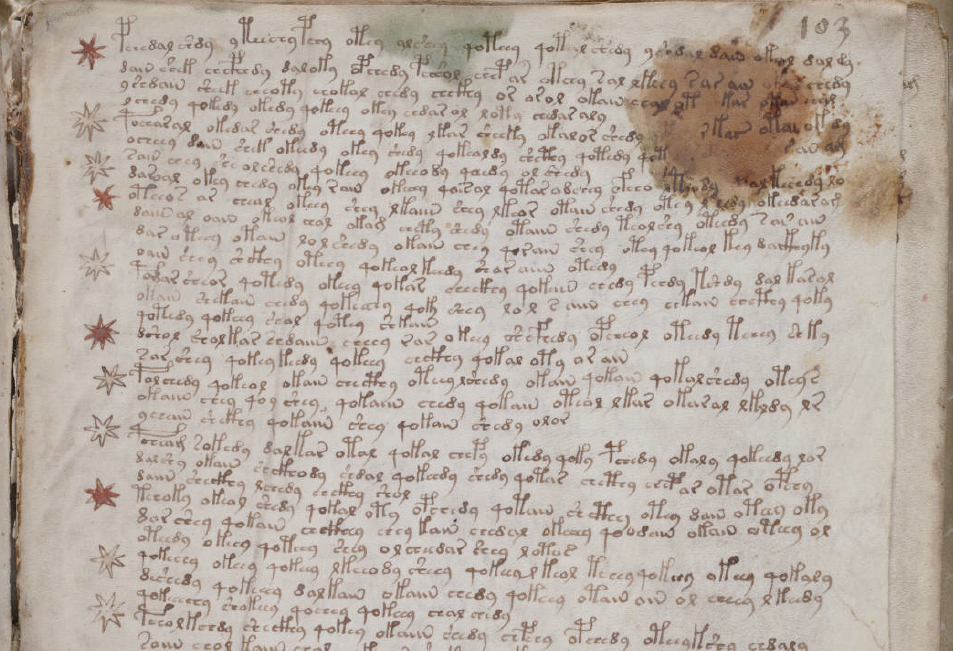
Procedural translation — f103r.8 to f103r.15
L8 — f103r.8
[ORG] daroal.okey.chedy.okey.rain.okechy.qoisol.qotar.adchey.ofcho.lteody.oral.kechdy.lo
[ACA] give to (bridge) · [OKEY] (deixis/slot) · controlled cooking · [OKEY] (deixis/slot) · [RAIN] (state/portion) · with which/to which (cui) · isolation/separation scope · [QOTAR] (adjustment/tare/measure) · to which/so that · surface “flower”/foam (supernatant) · concentration/strength correction · [ORAL] (positional marker) · from here/from this point · [LO] (article)
[FUN] Apply the “give to” chaining to hand the operation to the indicated point/slot; perform controlled cooking and keep the procedure anchored at the same point. Upon reaching the state/portion marked by RAIN, connect “with which/to which” to bind the target and then activate the isolation/separation scope. Perform the measure/tare adjustment to satisfy the purpose (“to which/so that”), remove the surface “flower”/foam as a clarification indicator, and carry out the localized strength correction. Next, mark positioning (“now there/at that point”), advance “from here/from this point,” and close with the final article (syntactic conclusion).
Normalization notes (L8):
-
chedy→ fits very well with KCHEDY (controlled cooking). -
okechydoes not exist as an isolated lemma; the most stable functional fit is KECHY (“with which/to which; cui”). -
qotar,okey,rain,oral,lodo not appear as exact lemmas in V27.47 A (they remain pending validation / via variants).
L9 — f103r.9
[ORG] oteeos.ar.cheal.okeey.shey.lkaiin.shey.lkeor.otain.shedy.otey.l.ledy.okeedaram
[ACA] portions of material (OTEOS) · toward/to · to which · [OKEEY] (deixis/anchor) · sealing/closure in progress · [LKAIIN] (completed/relational state) · sealing/closure in progress · liquor/solution (payload) · [OTAIN] (sealed state/container) · sealing/closure · obtain/extract · [L] (elided article “l’”) · “of the” (genitive fem. pl.) · “from here onward (mode)”
[FUN] Separate the material portions and direct them to the referenced target (“to which”). Anchor the procedure at the indicated point (okeey) and keep sealing active until the set enters the completed state (lkaiin). Then, under sealing, introduce/associate the liquor/solution (lkeor) and stabilize the state/container indicated by otain. Reinforce the seal (shedy), obtain/extract the designated fraction, and close the source with a genitive (“of the…”). From here, operate in the procedural mode “okeedaram” (internal continuity marker of the protocol, not a geographic reading).
Normalization notes (L9):
-
oteeos→ graphic variant that fits OTEOS/OETEOS (OTEO portions). -
otey→ functionally fits OTEEY (“obtain/extract”). -
lkaiindoes not exist as an exact lemma; nearby candidates coherent by function: ALKAIIN / OLKAIIN / LOLKAIIN (the “-AIIN” family: completed + connective). -
okeey/otain/lare strong formal anchors, but need validation as exact lemmas (or as an elision rule).
L10 — f103r.10
[ORG] daiin.ol.oain.okeol.chal.okam.chety.shedy.otaiin.shedy.teolshy.oteedy.sarain
[ACA] fixed/settled state (D- family) · to/for the · pivot/micro-block (“an” marker) · compartment/anchor slot (apparatus) · lime (alkaline base) · slotted apparatus (instrumental fit) · “these items” (deictic plural) · sealing/closure · [OTAIIN] (fixed state) · sealing/closure · sealing oil (oily seal) · [OTEEDY] (cloth step / cloth filtering) · [SARAIN] (saline fraction)
[FUN] After settling into a fixed state (daiin), direct to the block pivot (oain) and operate in the apparatus compartment (okeol). Apply lime as an alkaline base at the instrumental fit (okam) and work the designated set (“these items”). Seal/close (shedy), declare/ensure the fixed state indicated by otaiin, and seal again. Apply the sealing oil (teolshy). Then perform the cloth step (filtering/holding the phase) (oteedy) and finish by collecting/defining the saline fraction (sarain).
Normalization notes (L10):
-
otaiindoes not appear as an exact lemma; AIIN exists (fixed state) and many “…TAIIN” families exist, but OTAIIN requires validation. -
oteedydoes not appear as an exact lemma; nearby candidates: OTEDYL (cloth/textile/filtering family) and other “OTEED-” compounds. -
saraindoes not appear as an exact lemma; nearby candidates by function: SARAIIN (fixed state) and SAR.
L11 — f103r.11
[ORG] dar.oteey.otain.lol.shedy.okain.chey.qorain.shey.otoy.qokeol.key.daikhyky
[ACA] step/action (DAR) · obtain/extract · [OTAIN] (state/container) · [LOL] (article “o/lo”) · sealing/closure · central slot (main chamber) · [CHEY] (relative bridge) · [QORAIN] (temporal scope “as of now”) · sealing in progress · [OTOY] (pour in measure) · operational reinjection into the vehicle (OL portion) · [KEY] (“here/at this point”) · [DAIKHYKY] (unattested)
[FUN] In the step (dar), obtain/extract what was produced and stabilize the state/container (otain). Keep the system sealed and operate in the central slot (okain), binding the reference with the relative (chey). Mark the subcycle timing (qorain), keep sealing active, and then pour the prescribed measure (otoy). Perform the operational reinjection of the vehicle (Q-cycle in qokeol), anchor “here/at this point” (key), and execute the specific gesture daikhyky (still without a stabilized lemma in the dictionary).
Normalization notes (L11):
-
qorain→ very likely a variant of QOIRAIN (temporal scope “as of now”). -
otoy→ functionally fits QOTOY (quantified pouring). -
key→ functionally fits EKEY/OEKEY/LKEY (“here/at this point” anchor). -
daikhykydoes not appear as a clear lemma/candidate in V27.47 A.
L12 — f103r.12
[ORG] oain.shey.shckhy.oteey.qokeol.keedy.shar.aiin.otedy
[ACA] pivot/micro-block (OAIN) · sealing in progress · [SHCKHY] (check/verification) · obtain/extract · operational reinjection (active slot) · “from here” derivative / product-in-progress · tighten/seal (command) · fixed/completed state · [OTEDY] (cloth/filtering)
[FUN] Mark the block pivot (oain) and keep sealing active. Execute the check/verification of system state (shckhy), then obtain/extract the target fraction and reinject into the cycle at the active slot (qokeol). Continue by working the derivative/product-in-progress (keedy), tighten and seal (shar), and declare the fixed state (aiin). Finish with the cloth/filtering step (otedy), preparing the next transition.
Normalization notes (L12):
-
shckhy→ most stable functional candidate: LSHCKHY (check/verification). -
otedy→ nearby candidate: OTEDYL (cloth/textile/filtering family).
L13 — f103r.13
[ORG] podar.sheor.qotedy.okeey.qokar.checkhy.qokain.chedy.pchdy.tshdy.dal.kasol
[ACA] [PODAR] (vessel load / payload pre-routine) · sealing in progress · [QOTEDY] (unattested QOT- form) · [OKEEY] (point anchor) · selective reinjection (“as to which”) · under control/checking · central reinjection (saturation slot) · controlled cooking · pitch/tar (binder/sealant) · [TSHDY] (calcined tartar / light roasting) · from/of (origin) · operational adjustment/dosing
[FUN] Prepare the vessel load (payload routine: podar) and keep closure (sheor). Execute the QOT- command written as qotedy (subcycle sequence/measure) and anchor the step at the indicated point (okeey). Perform selective reinjection (qokar), keeping everything under control (checkhy), and return to the central reinjection slot (qokain) to increase saturation/efficiency of the cycle. Apply controlled cooking (chedy), use pitch/tar as a sealing/binding medium when required (pchdy), carry out the calcination/light roasting routine (tshdy), mark the origin (dal), and adjust the operational dosing (kasol).
Normalization notes (L13):
-
podar→ nearby candidates: OPOD / PODAROAR / PODAIR (POD family “vessel load”). -
tshdy→ very strong candidate: OTSHDY (calcined tartar process / light roasting). -
qotedyremains without an exact lemma; QOT and derivatives exist (e.g., QOTEEEY), but QOTEDY needs validation.
L14 — f103r.14
[ORG] okain.shekain.chedy.qokeechy.qoky.shey.lol.s.aiin.chey.eekain.chcthy.qoky
[ACA] central slot · [SHEKAIN] (control/sealing in progress) · controlled cooking · [QOKEECHY] (operational reinjection) · short genitive “of/from” (+ Q-cycle) · sealing in progress · [LOL] (article) · [S] (marker/punctuation) · fixed state · [CHEY] (relative bridge) · transition “and which/which ones” · “that which/what” · QOKY (genitive/return bridge)
[FUN] In the central slot (okain), maintain sealing control (shekain) and conduct controlled cooking (chedy). Execute the operational reinjection indicated by qokeechy, and use qoky as an origin/possession bridge (and, when relevant, as a return marker for the Q-cycle). Keep sealing active (shey), fix the state (aiin), connect the relative (chey), and mark the “and which/which ones” transition (eekain) to qualify “that which/what” (chcthy). Reapply qoky to close the genitive/return link.
Normalization notes (L14):
-
shekain→ direct candidate: LSHEKAIN (sealing/control). -
qokeechy→ nearby functional candidate: QOKEECHEY (operational reinjection operator). -
sdoes not appear as an isolated lemma in V27.47 A (likely an internal marker/punctuation in your segmentation system, or an elision).
L15 — f103r.15
[ORG] qotedy.qokeey.shol.qotey.shkain
[ACA] [QOTEDY] (unattested QOT- form) · [QOKEEY] (selection/quantification + reinjection) · oil bath / oily medium · [QOTEY] (ordered continuous flow) · dosed alkali portion
[FUN] Execute the QOT- command (sequence/measure) in the form qotedy, and apply the selector/dose (qokeey) to determine the instance of the material in the cycle. Run this segment in an oil bath (shol), maintain the ordered continuous flow (qotey), and finish by applying the dosed alkali portion (shkain) at the strength required by the step.
Normalization notes (L15):
-
qokeey→ directly fits QOKEY (selection/quantification; also used as a reinjection operator in the Q-cycle in LF). -
qotey→ very strong functional candidate: QOTEEEY (ordered continuous flow). -
qotedyremains pending (see L13).
Synthesis of what this section “seems to be doing”
This block (L8–L15) looks like a closed subroutine with:
-
sealing cycles (SHE*, SHAR, SHEDY) to control phase/pressure/volatility;
-
isolation/selection and reinjection (QOISOL, QOKAR, QOKAIN, QOKEOL, QOKY/QOKEY) suggesting a feedback loop (cyclical washing, saturation increase, controlled repetition);
-
thermal control (KCHEDY via the variant “chedy”) and oily sealing (TEOLSHY + SHOL), typical of steps where volatility must be tamed;
-
point/timing markers (QOIRAIN via the variant “qorain,” and deictics like …KEY/OK…) acting as “addressing” for the apparatus and the moment in the cycle;
-
finalization by dosing adjustment (KASOL) and application of a dosed alkali (SHKAIN), consistent with microdosing / pH control / extraction.
This is exactly the kind of pattern that supports your “executable text” thesis: the text does not narrate, it orchestrates.